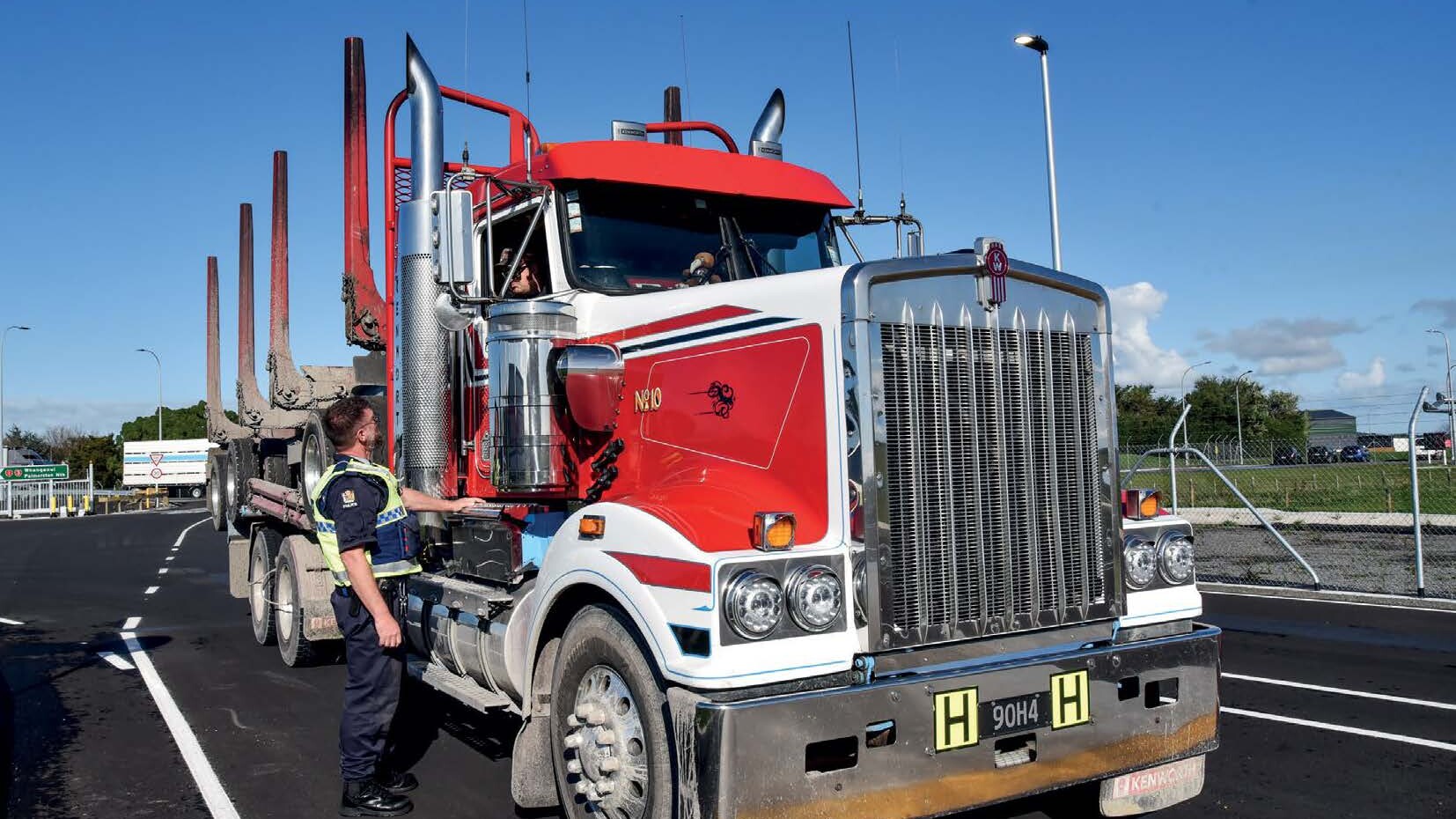
Photo above: Senior constable Vaughan Patching chats to Chris Mallett from McCarthy Transport, who was soon on his way after a quick check.
The new commercial vehicle safety centre at Ōhakea in Manawatu opened in May. New Zealand Trucking magazine paid a visit to see how it operates.
The new centre on Pukenui Road State Highway 1/3 is the fifth of 12 centres NZTA is building or renovating on high-volume routes. More than 2000 heavy vehicles travel this road each day and until recently, identifying which ones were non-compliant was a bit of a lottery.
The centre is linked to in-road weigh in-motion scales and automatic number plate recognition (ANPR) cameras in both directions two kilometres from the facility. The system can be set to require all trucks in one direction or both to stop, it can signal only non-compliant trucks, it can target transport service licences, and it can randomly select trucks even if no issues are raised. The randomised function accounts for things that can’t be screened for, such as fatigue and impairment.
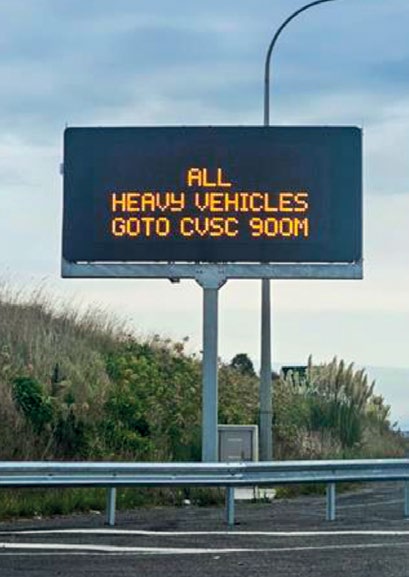
As a heavy vehicle passes over the high-speed weigh-in-motion plates, the information relating to it appears on a screen in the centre. This includes its weight, what permits the vehicle has, whether the road user charges (RUC) are up to date, and if there are any issues with the truck or the operator that have been flagged in the past. If there are any issues, that truck’s registration number will be displayed on a variable message sign (VMS) and it will be directed to the centre. Failing to stop can incur a $1000 fine.
NZTA programme manager regulatory Sean Bridge says the ability to integrate systems nationwide will enable NZTA and the police to have a more targeted approach to compliance and risk on the roads.
“If any truck that goes over the weigh in-motion technology is non-compliant, police manning the site at the time will get an alert that this truck is non-compliant for whatever reason – its weight, it may not have a CoF, the RUC isn’t up to date and it gives the police the opportunity to signal that truck to come in to the site.”
The system will operate 24/7, and if a non-compliant vehicle is picked up when the centre is not staffed, NZTA can place that vehicle on a recall list or follow up with the operator.
“Our screening technology picks up things like unpaid RUC. If you’re not paying the correct amount of RUC you may be able to undercut contracts, so being able to screen on that 24/7 gives good buy-in from our industry partners. It is all about having a level playing field for everybody.”
Police Area 3 manager CVST senior sergeant Matt Arthurs says a focus on overall compliance will result in a decrease in death and serious injury on the roads. Noncompliance, coupled with intelligence data, directs vehicles into the safety centre, where the police interaction looks at the driver and the vehicle to ensure they are safe.
“We should also see a marked improvement in the condition of our highways over time – a lot of the damage is caused by heavy motor vehicles, so if the highways are in good condition, that will reduce the number of crashes.”
The time from when the weigh-in motion activates the VMS and signals the vehicle to come in to the moment it exits the compliance centre could range from two minutes to 20 minutes or more for a full inspection, says sergeant Paul Johnson, who heads the commercial vehicle safety team at Ōhakea.
“Once they come into the centre and over the weighbridge, we look at driver fatigue management, which is your work-time logbook. We do alcohol breath testing, we inspect the vehicle for faults and defects, we check the RUC and the hubometers or EROAD. We will also do dangerous goods and load security inspections. That won’t be on every vehicle; it’ll be on an ad hoc basis. We might do 10 in a row, then numbers 11, 12, 13 might be something that comes through every day that might be checked less frequently. Load security is one of the things we have issues with, especially with the curtainsiders because they rely on the curtain for load security,” says Paul.
If major defects are found, the police can order the vehicle off the road. “It happens more often than it should do,” says Paul. “Tyres and brakes are the two main ones, then there are things like broken windscreens or a truck at night with headlights or taillights that aren’t working. The other one would be the weight, where they’re so heavily overweight and they can’t move until they offload.”
Paul doesn’t want to single out any sector of the industry but says some operators have put a lot of time and investment into compliance.
“One operator previously had 20 to 25 of their trucks checked a day on the weighbridge across the road, and now we only see five a day, if that. That’s a really good example of a compliant operator who was getting stopped regularly, who now is only getting stopped when potentially there’s an issue. For compliant operators, it really pays off because they’re not going to get stopped as often.”
Paul says the difference between a compliant and a non-compliant operator can often be very small.
“You’ll get companies that are really good for five years, and then they’ll just go downhill, and other companies that have been non-compliant will have made improvements. A lot of that is probably from the amount of attention they get from us and from NZTA. There’s a lot of work that goes on in the background as a result of the enforcement stops we do – NZTA will follow up with the companies and work with them to be compliant. We also do prevention work with the companies; they call toolbox meetings where we go and talk to the drivers. We don’t do training, per se, but we answer questions and help where we can.”
Work-time offending is an issue police see on a regular basis and they can direct drivers to take a break. “If they’re just a little bit over, we’ll quite often direct them to nearby accommodation in Bulls or Sanson, which is only a couple of minutes’ drive. For a 10-hour break, you’re better to be in a nice motel, or at least in a place where you can access food, drinks … things like that. If it’s only a 30-minute break, quite a few will just park outside on the road somewhere and take the break before they continue. If it’s a 24-hour break, the company will send somebody to pick up the driver and take them away and have another driver take over.”
Paul says if a driver is working in the yard for six hours and then starts driving, those six hours are still part of their working day. “I’m aware of drivers who have taken their 10-hour break after working a full shift, and during those 10 hours they’ve slept for four or five hours, mowed the lawns, and taken their kids to school. All that adds to fatigue, but we can’t monitor that. The drivers have got to accept there’s some responsibility to ensure that they are resting properly.”
In addition to breath testing for alcohol, later this year roadside oral fluid tests to screen for drugs will be introduced. The consequences of a failed test will be a 12-hour park-up followed by infringement action and demerit points.
The number of staff at the Ōhakea centre varies from day to day, and can be as high as 15 to 20 when operations are being run. It includes police officers with additional specialist training in commercial vehicle enforcement, as well as vehicle safety officers.
as well as vehicle safety officers. “The centre is quite regularly open close to 24/7, but it’s not 24/7 every day. We cover those hours through different deployments with staggered hours to give coverage over 24 hours – it varies, and that’s to remain unpredictable as well,” says Paul.
In addition to their duties at the CVSC, Matt says the team also attend fatal crashes involving trucks. “One of the biggest killers of truck drivers is not wearing seat belts. What a seat belt allows you to do is maintain control of a vehicle in a minor crash, and it also means you’re restrained in the cab. A minor crash quite often turns into a major because you can’t control the vehicle. Wearing seatbelts is a message we struggle to get through to people.”
While it is called a commercial vehicle safety centre, Matt says enforcement is an important part of their role. “Ours is a really interesting industry, because in theory, we shouldn’t have much work to do if all the companies and the systems were working properly. The centre gives us a real opportunity to target non compliant operators and focus on bringing them up to a standard where they and other road users are safe, as well as contributing to their commercial use of the network.
“If we get non-compliant operators, we can easily direct all of their vehicles to stop based on the transport service licence, and that will result in them getting pulled in anywhere around the country for checks. We’ve got a really good tool to target non-compliant operators and the biggest message to the industry is to invest in your own systems and compliance, and invest in your own people, because those who do so see the benefits of it.”
Matt says police interacting with a driver can often be the last straw that breaks the camel’s back, the last thing on a bad day. “However, aggressive drivers are extremely rare and a lot of that comes down to the people we have working for us and the way they interact with drivers. They’re a fantastic bunch of people with a very caring nature who are passionate about what they do.”
The last word on the commercial vehicle safety team goes to a truck driver. “They are not the enemy. They are there to ensure compliance, and we actually need that.”
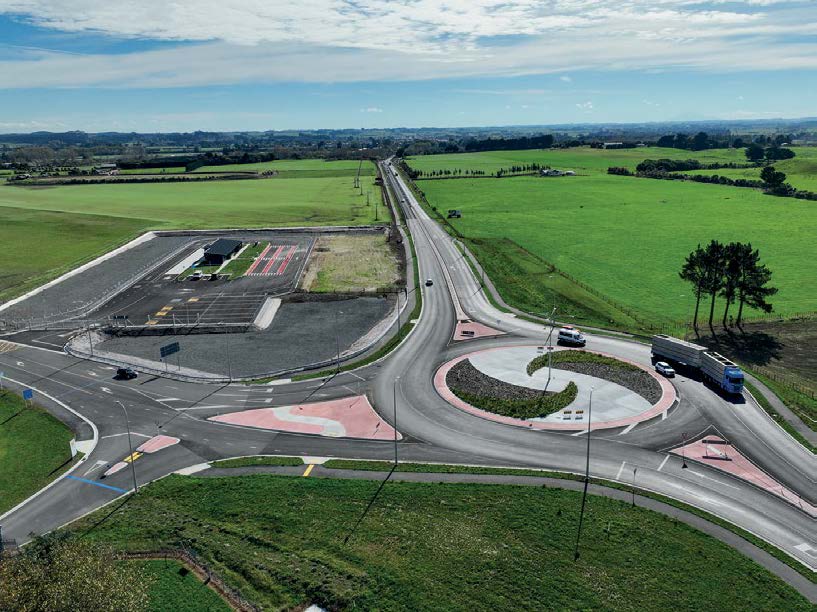
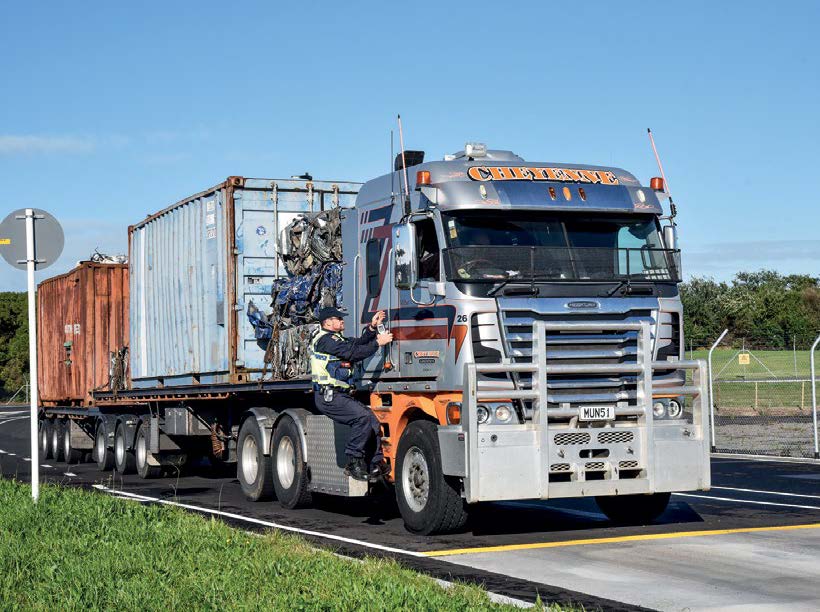
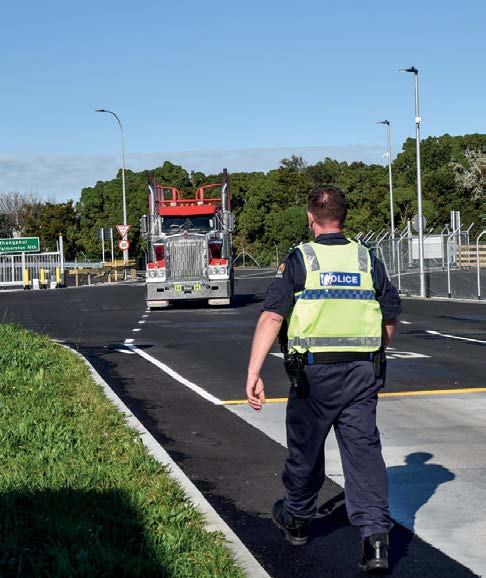
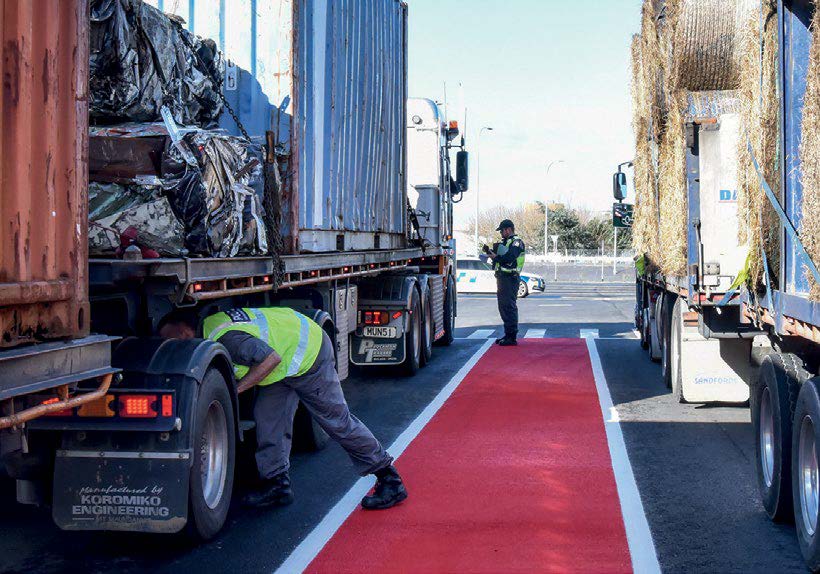
1) An aerial view of the Ōhakea Commercial Vehicle Safety Centre. Image: NZTA. 2) Constable Jonathan Greene explains what happens next to Alex Clarkin from Cheyenne Logistics. 3) Senior constable Vaughan Patching approaches a truck coming into the centre. 4) Vehicle safety officer Michael Clark thoroughly checks one of two trucks at the centre.
More about CVSCs
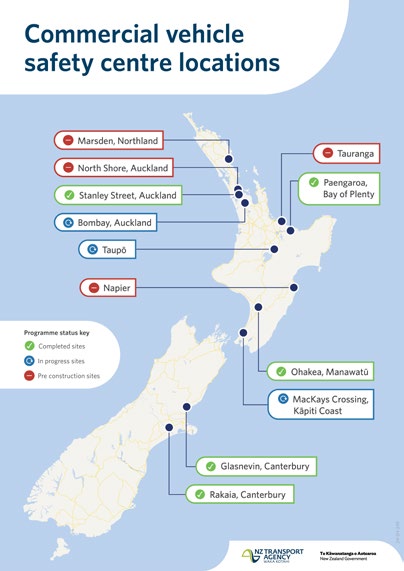
Commercial vehicle safety centres (CVSCs) are sites where police can carry out thorough inspections of heavy vehicles. Vehicles will be screened for potential safety issues, such as not having a current CoF, road user charges not enough for the weight carried, exceeding the maximum allowable weight, the load status of the vehicle checked against its permit, and previous safety-related concerns. Driver fatigue will also be screened. For example, if a vehicle has passed two or more CVSCs within a certain time, it shows as a work-time breach. Existing CVSCs are being upgraded and new sites added to create 12 CVSCs on high-volume routes throughout New Zealand, covering 46% of the heavy vehicle kilometres travelled. There will be eight regular-size CVSCs and four larger ones. Regular CVSCs will have a weighbridge, in-road technology and a simple onsite office, with the capacity to be upgraded if required, while larger CVSCs will have a weighbridge, in-road technology, an inspection shed, roller brake machine, inspection pit, and office block. Centres in Glasnevin, Paengaroa, Rākaia (southbound), Stanley Street (Auckland) and Ōhakea are operational. Seven further CVSCs will be located at Marsden (Northland), Bombay, North Shore (Auckland), Taupō, Tauranga Port, Napier, Mackays Crossing (Kāpiti), and Rākaia (northbound). The centres are owned by NZTA and funded through the National Land Transport Fund.