
CAPTAINING SUCCESS – BTS 2025 Report

Penske hosted its annual media event during the Brisbane Truck Show this year, and the message was all about the brand – and no, that’s not a missing plural.
For the bulk of the globe’s vehicle-oriented types, the name Penske is immediately associated with success on the motorsport circuits of the world. If your particular automotive bent is road transport, that connection will likely arrive front of mind shortly after.
‘A diversified on-highway transport services company’ is how the Penske Group’s global website humbly puts it – vehicle leasing/rentals, logistics, OEM agencies, manufacturing, power generation … it goes on and on. While the list of business units, the US$43 billion in annual revenue, and 73,000 employees boggle the mind, the real test of neural malleability comes when you take on the reality this is a one-man, in one generation, business: Roger Searle Penske, aka ‘The Captain’. His name carries such sway in the global automotive ecosystem that things like the Australasian enigma, where marques from both Traton Group and Daimler cohabitate happily under one representative roof, are simply part of daily life. Penske – your MAN and Western Star dealer.
“In the past, we’ve probably led with our brands [MAN/Western Star/Dennis Eagle/ Detroit] and while we’re certainly not diminishing that, this is where we’re really going to talk about the Penske brand.” These were the words of managing director for Australia and New Zealand, Hamish Christie Johnston, on the eve of the Brisbane Truck Show this year. The physical symbolisation of the intent was the Porsche 963 world endurance race car at the centre of the Penske stand. While the walk-through masses were likely oblivious to its hidden message, any ‘gimmick’ snipes levelled Penske’s way by the opposition might well be recalled in time, should Roger’s team follow through on its intent.


Hamish Christie-Johnston (left), managing director for Penske Australia and New Zealand, and general manager on-highway for Australia and New Zealand, Craig Lee, delivering the Penske message to media at the pre-opening media walkaround.
The ‘drivers’
What’s brought about channelling their ‘inner Roger’? A number of things, but first, let’s not forget motorsport’s most valuable mantra – prior preparation prevents poor performance.
Over recent years, Penske has invested significant amounts in support facilities, training, aftersales networks, recruiting, and advanced parts distribution in this part of the world – it’s certainly not hard to see the evidence here. In the words of executive general manager on-highway for Australia and New Zealand, Craig Lee, “We’re increasing the number of dots on the map. We’ve all heard stories where the front end gets ahead of the back end. We wanted to ensure we had the back end of the business organised before we went and pumped big volumes of product into the front end.”
The ‘dots’ will continue to be a mix of company and independently owned facilities strategically placed to ensure a 50/50 split in product volume throughput and national coverage.
The alignment of the business with future supply environments is another causation. As sobering as it might be for us old ‘heartstringers’, trucks as a service dominating a future world is the reality, and the Penske brand is core to this space. Lease and fleet maintenance programmes are only the start.
Then there are the products – and an element of market share inertia just currently. The new-generation Detroit Diesel engines are returning impressive reliability and performance metrics as the first units in the field reach the magic 1,000,000km.
“Detroit’s new motors needed real numbers, and the numbers are great,” says Bob Gowans, Detroit business manager, Penske Australia.
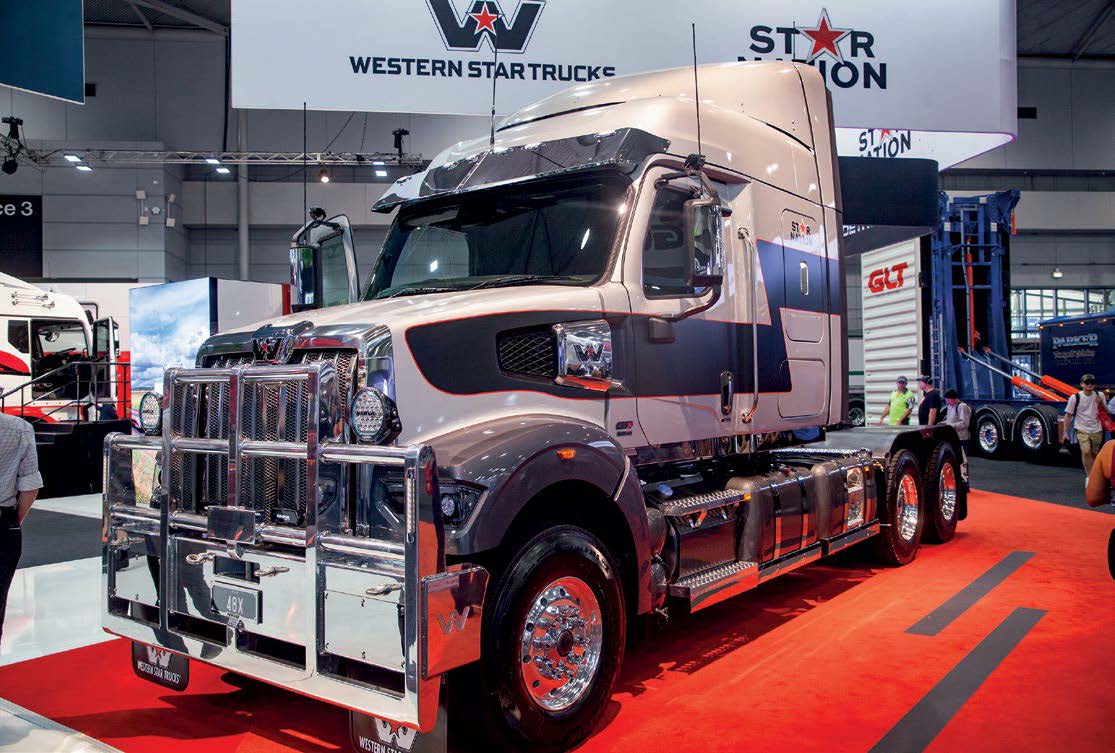
The other big spend in all this is the Western Star 48X, the Daimler Truck North America (DTNA) product developed specifically for Australasia. They’re entrusting Penske to deliver on their need for a return also – evidenced by the complete absence of 49X on the BTS stand. There’s no question there was room in the market for 48X. Penske, VGA, and let’s not forget Freightliner, all believe they have products at the heavy end of the market that can keep Bayswater honest … on both sides of the Great Dividing Range.
In 48X, you could argue Penske has the pole-sitter. It hits the 600hp Aussie B-double compatible sweet spot and comes as an 8×4, giving it wide appeal in the Land of the Long White Cloud as well as the mutant Ninja world of Aussie PBS.

Beyond the red flags
It’s not like we didn’t know harder times were coming, but for Penske’s on-highway truck and engine businesses, the timing was frustrating, if not a little painful. At a time in history where both MAN and Western Star have stellar offerings, sales have certainly not threatened the record book in a way they’d like – the last 24 months in particular.
“48X [Western Star] is a ground-up build for a right-hand-drive market – that’s a huge investment, and right now, we’re not really getting the penetration we’d like to see,” says Lee. Pulling back a little to the wider view, in 2025, the Detroit Diesel driveline penetration is now directly proportional to the success of its parent marques. “We need to do better with that product in terms of representation and market share. We have a product that can outperform many others on the road, and it’s up to us to present that product better. It’s a damn good engine and transmission.”
Few would argue that taking a field of diamonds approach and bringing every quality that put the Captain’s name on race cars and buildings the world over, is an ideal strategy when recovering from the long-Covid economy. Best practice, never being satisfied, continual benchmarking, a smitten customer base, and a myopic interest in one podium position only, will certainly get you places.
The thing is, now Penske has said it’s going to draw on its inner philosophical armoury and do it. Buckle up – shit could be about to get real.
OVALS AND OHMS
While there is activity in the EV bus space, Penske in this part of the world is a little more reserved when it comes to BE heavy trucks. With the flow of energy currently, the resistance is a little perplexing.
“It’s coming and we have the answers, but the environment is not ready,” said Hamish Christie-Johnston, managing director for Penske Australia and New Zealand. One of the main concerns is the nature of the grid, with Australia’s generation being 60% fossil fuel and 40% renewable. Given the entire Penske empire was built on the back of fossil fuel’s influence and opportunities, you could argue that electricity generated from dead trees and dinosaurs is their old mate’s parting gift, allowing them to grab a foothold before it possibly bows out. Even if you’re not the romantic kind, isn’t the national power generation profile really a central government issue?
Looking in, it would be hard to find a business more able to crush opportunities in the heavy BEV space. The generation and electrical storage business is one of the most profitable, and the IP resident within the unit is currently the supply chain’s most valuable commodity, much less having the capability to install the end solution as well.
In MAN eTruck, Penske also has access to one of the world’s slickest OEM BEVs. The dowry of generation and storage support eTruck could bring to a large customer’s supply chain solution is unmatched in the local road transport supply industry. “The grid and economies are preventing it coming to market at scale as soon as people would like,” said Chris Sharp, MAN Truck and Bus head for Australia and New Zealand.
But there’s no question the market is interested. One of the big news breaks in Truck Show Week was the 30-truck EV deal logistics giant Linfox did with a key competitor. Maybe it’s a case of having the IP Penske does that allows a smarter long game, and when 2030 mandates roll around, the five red lights might well go out properly.