
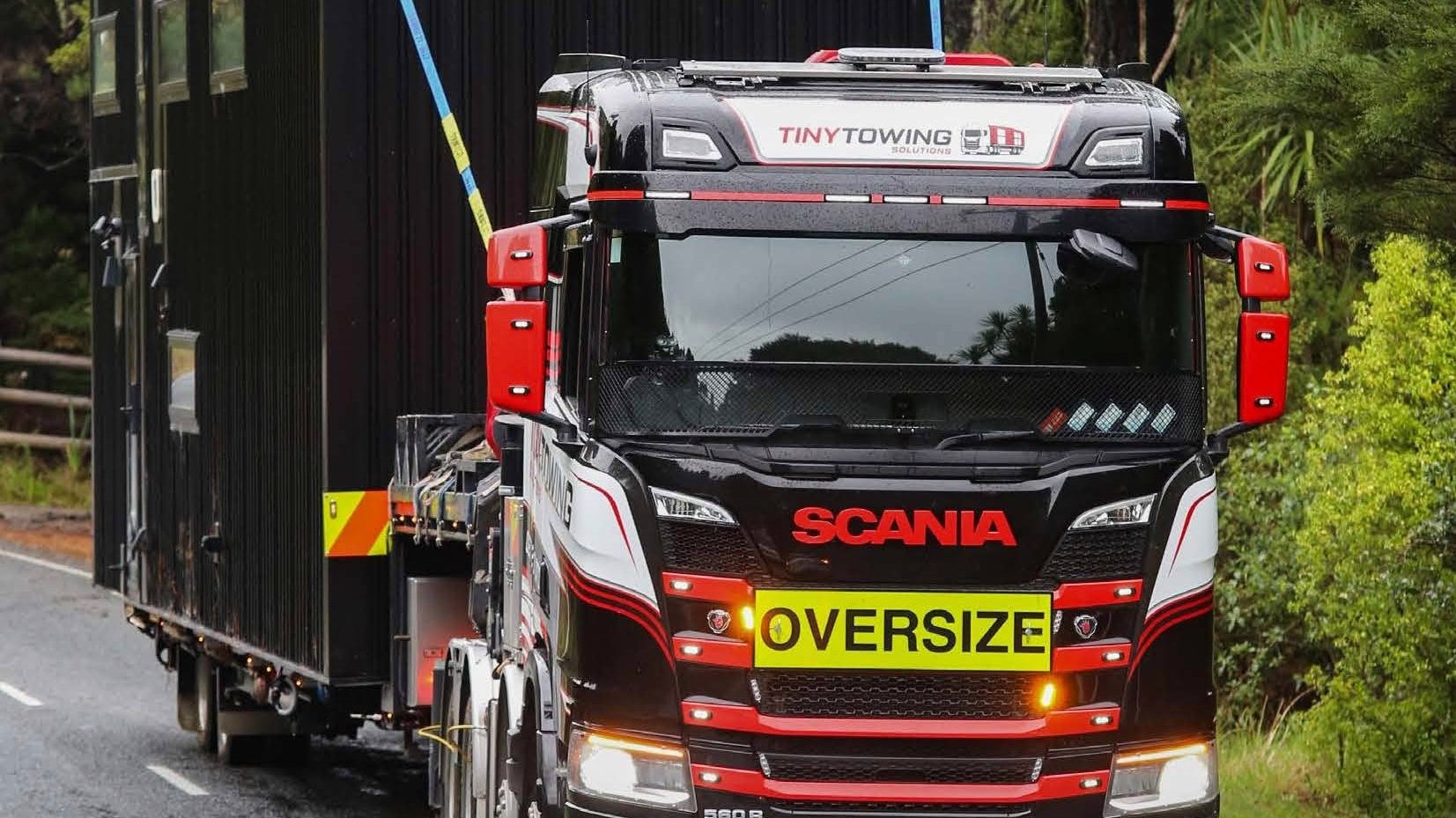
The tiny house industry has exploded in New Zealand over the past five years or so, with compact, transportable homes popping up in weird and wonderful spots nationwide. Naturally, they need to be moved to site and into position, and a handful of specialist movers have entered the scene in recent years – although we’re not sure any of the others have the same level of on-road equipment as Te Aroha’s Tiny Towing Solutions. The homes may be tiny, but if the latest addition to the company’s fleet is anything to go by, being a specialist tiny house transporter is serious business.
Great Barrier Island, Waiheke, the Catlins, Milford Sound, Matakana, Invercargill, Kerikeri, Christchurch, Ahipara, Rotorua, Bluff, Greymouth, Puatāruru … Name a place in New Zealand and there’s a high probability you’ll find a tiny house there. And the chances are that if it’s in one of these or any number of other places around the country, Tiny Towing Solutions may have moved it there.
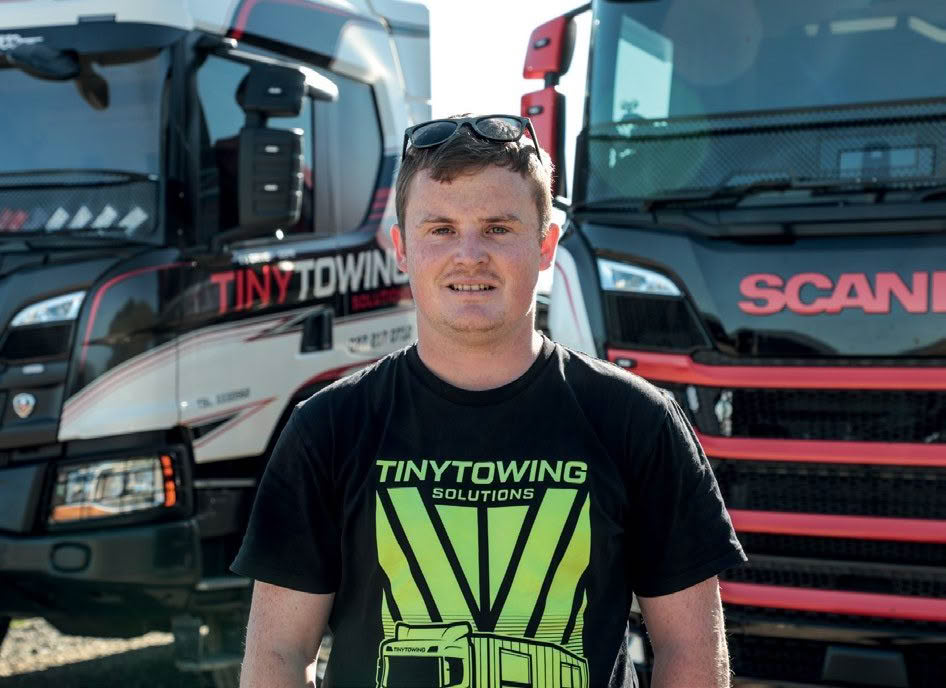
“Yeah, we’ve done three or four to Great Barrier, about a dozen to Waiheke … Milford Sound, that was interesting – we weren’t going to fit through the Homer tunnel with the house on the trailer, so we had to unload it and use the ute to drag it through the tunnel on some little custom-fitted wheelbarrow wheels. Then we had to get the transporter through and load it back up. Yeah, it was tight,” says company director Angus Hamilton.
“I’m big on ‘We’ll make it work’,” he adds.
After three days with Angus, driver Rob Pettifer and the Tiny Towing team, a culture of not letting anything get in the way of completing the job is clear. To be fair, they really couldn’t have any other attitude when you consider the hideous locations of some tiny houses (from an over dimensional truck driving and hiab-operating perspective, that is – many places are scenically quite stunning, actually). There’s a lot of due diligence ahead of the fact, but a fair bit of thinking on your feet in the heat of the moment. This is not a typical trucking job, nor is it just a job you need a truck for. No load or destination site is the same. Having the right tools at your disposal and the right team on the job is critical.
Indeed, for a company that is not even a full five years old yet (see sidebar Seizing opportunity), what Angus has managed to build in such a short timespan is commendable.
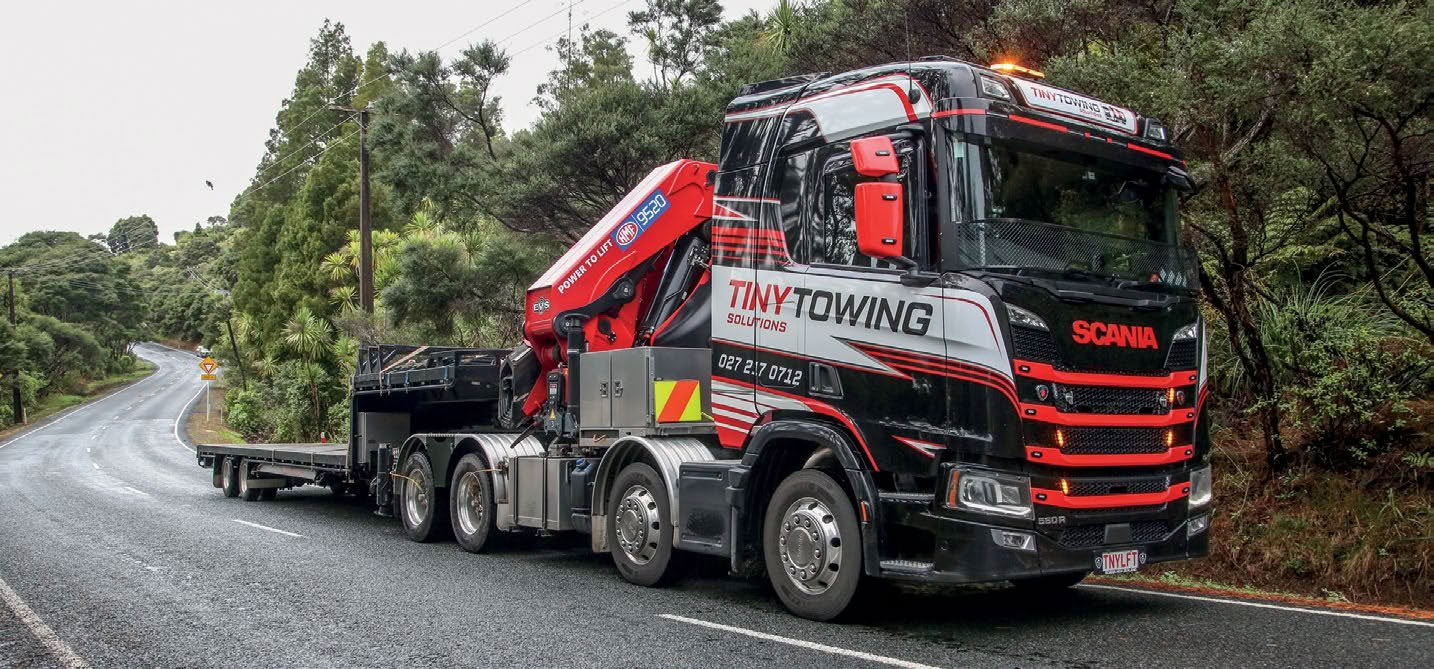
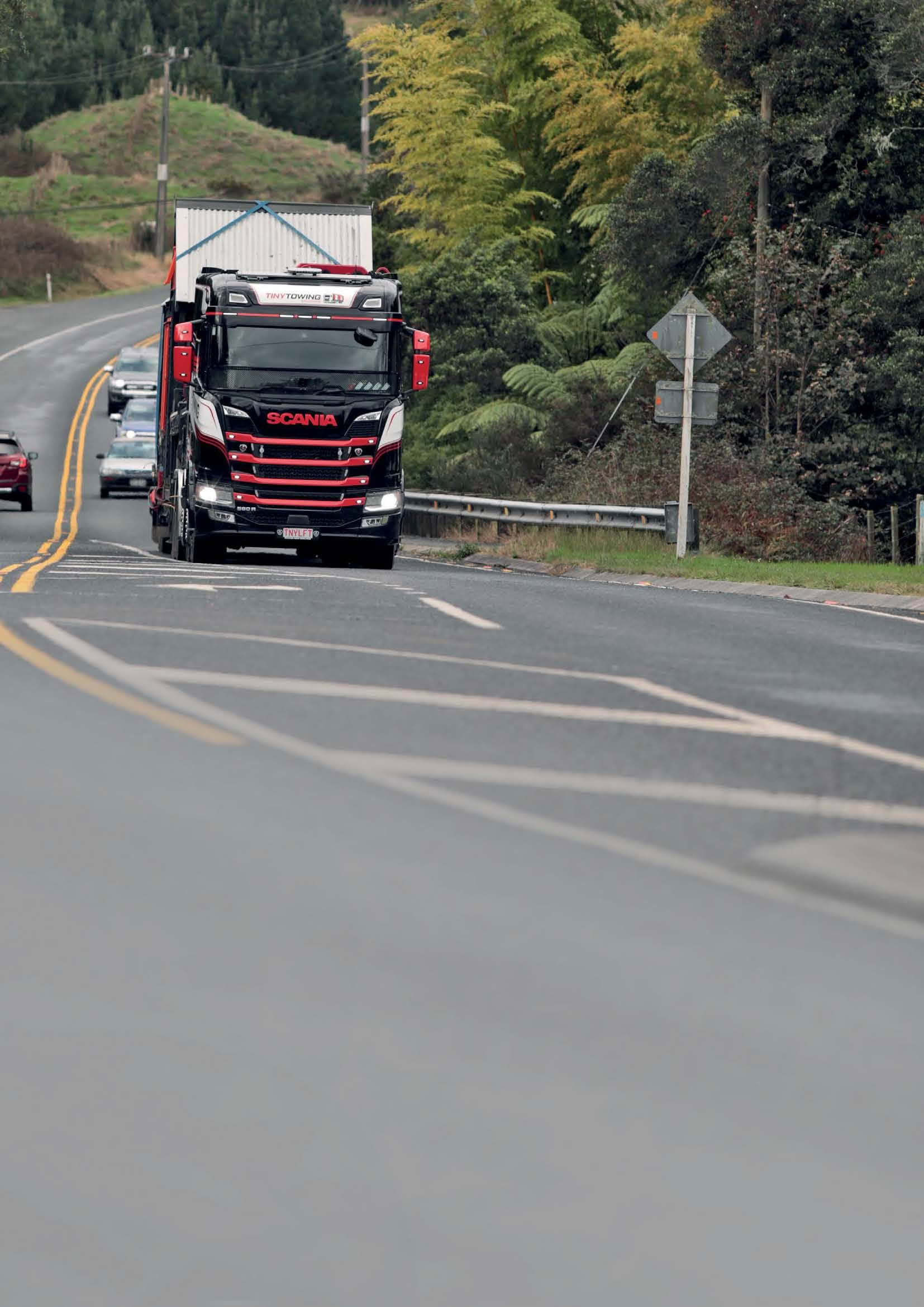
And it’s all culminated in the latest, most specialised unit yet in the fleet, this Scania 560R 8×4 crane truck and two axle SEC step-deck trombone semi-trailer combination.
A process of evolution
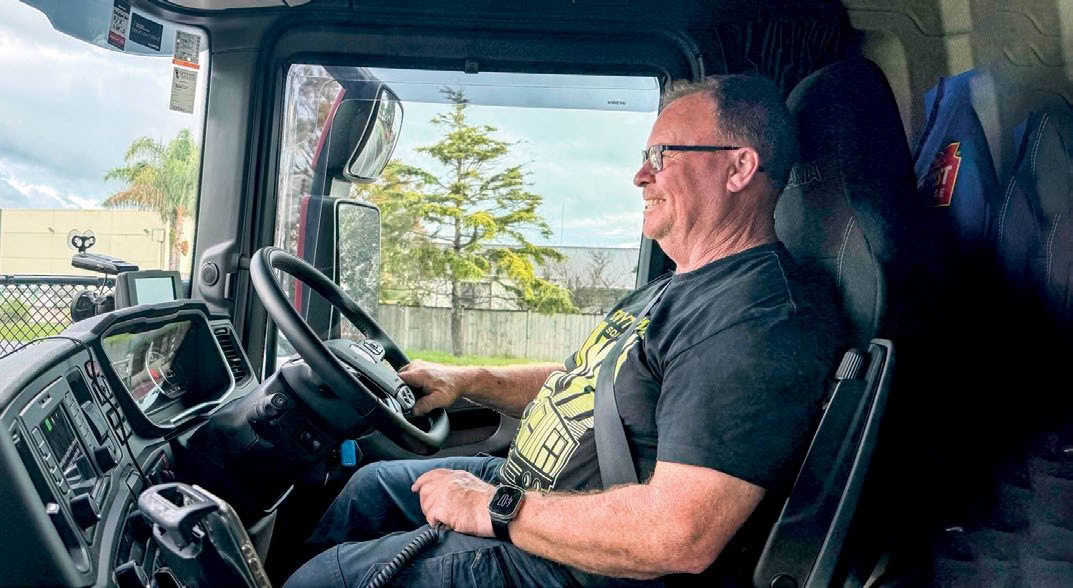
In little more than a couple of months on the road, the 560R has already done multiple South Island trips and clocked up upwards of 15,000km. Timing being what it was, we met Rob and the big Scania in the weeks between a couple of jaunts to exotic, faraway, inter-island locations. That was okay, though, because, as much as we’re still hankering for that elusive inter-island feature, what we got were a trio of scenarios that gave some insight into how varied the truck’s operation is and what the Tiny Towing team may encounter in a day’s work.
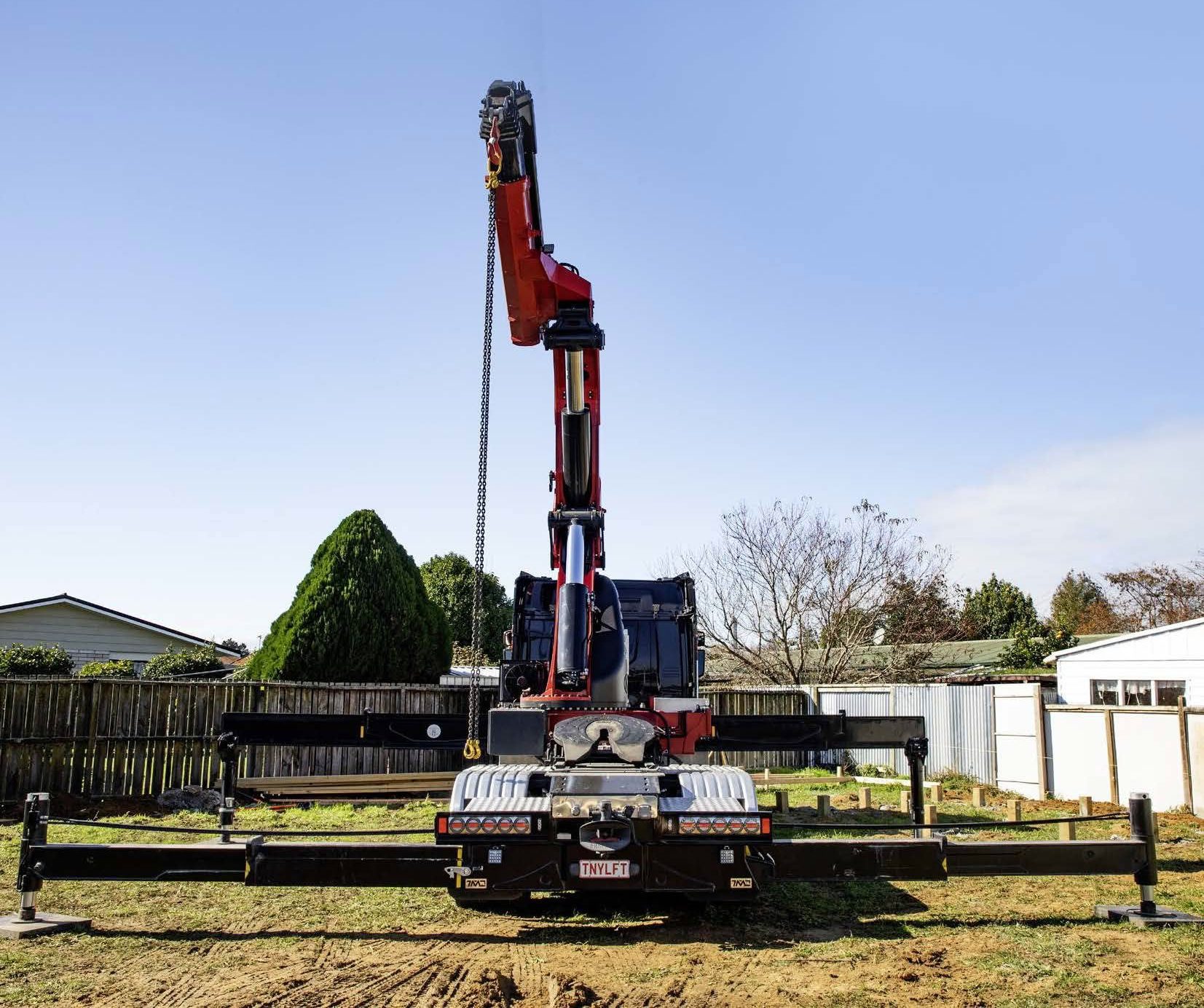
But, before we fire up the PTO and extend the mightily impressive HMF 9520OK-RCS knuckle-boom crane, let’s first get to know what we’re working with … there’s a lot to unpack in the 19m between the Scania’s front bumper and the 500mm hydraulic extension tucked neatly in the back of the SEC semi. Everything down to the positioning of the lockers and the custom spreader bar for the crane has been thought about.
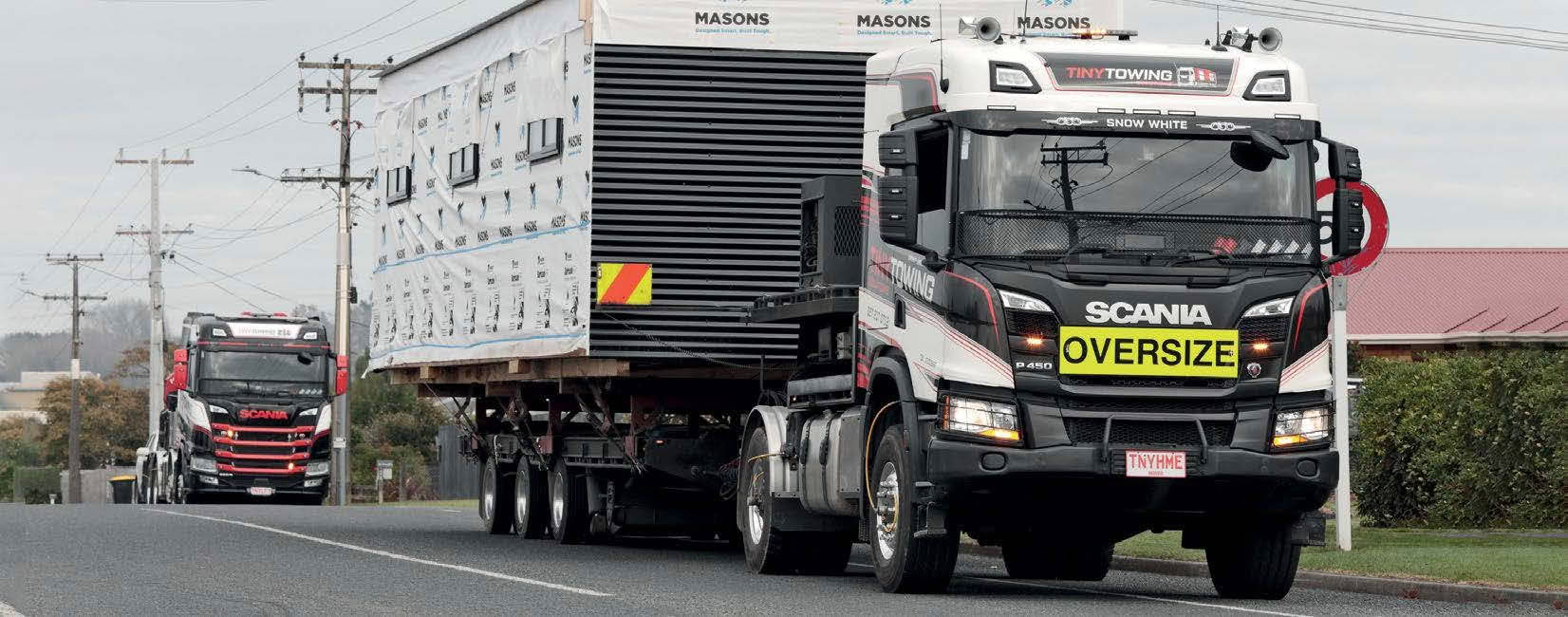
The Tiny Towing fleet consists of four trucks – an Iveco Eurocargo ML150E28 4×4, a Sinotruk G7 6×4 (incidentally, a great truck, says Angus), a Scania P450 XT 4×4, and the new 560R 8×4 crane truck. All are tractor units so that each can tow any of the company’s three semi-trailers and be deployed in whatever combination best meets the unique scenario of each job.
“I bought two Ivecos through Robbie Greenhalgh, and when he moved to Scania, he tried to on-sell me to Scania. I’d wanted a Scania for ages, but at the time, there was a two-year wait, and I couldn’t do it.
He happened to ring me one day to say spots had opened up, and it was now a four-month lead, so that’s when I ordered the XT. It went on the road about a year ago now. It’s pretty much a fert spec truck, but they’re a day cab on spring suspension and we specced airbags and a sleeper cab, as well as bigger tanks for on-road use,” explains Angus.
It was always clear that having a crane truck would be a huge advantage for the business. “We were spending thousands a month hiring local hiabs around the country,” Angus says. “And, with the new 70m² granny flat rule coming in later this year, I expect that will increase the amount of lifting onto piles we’ll be doing.”
In June 2024, Angus started investigating his options, looking at an Iveco S-Way in stock, but it did not offer enough lift on the airbags. However, a cancelled order had availed itself at Scania …
“I had a look at it with Robbie, and it was the perfect spec; the right wheelbase, big fuel tanks, and airbags with 150mm lift all round – that was one deciding factor. The other was the Scania’s load transfer. It allows you to shorten the forward distance and makes the truck turn on a dime – say, if you’re getting into a tight driveway,” Angus says.
Why not another XT? That’s all a matter of accommodating the weight of the big HMF. “The XT adds 180kg to the front axle. As it is, we’re kilogram perfect on the front axles. And if we went with an XT with a sleeper cab, that would add another 150kg. Every 100kg would push the crane back 50mm. At the moment, all our trailers clear the crane by 100mm with the fifth wheel right forward, so I didn’t want to push the crane further back. Even if we were to custom order an XT, we would’ve had to be mindful of weight issues.”
Fitting a crane of this size to a tractor unit was always going to be a challenge.
Ideally, the truck should’ve been a 10×4 – but that would never offer the level of manoeuvrability Tiny Towing needed. And, obviously, a rear-mounted rigid unit was never an option.
“It’s a bit more difficult getting your lift compared to a rear-mount crane, where you can back right up to the building. It meant we had to fit a much bigger crane. We went through every crane option and ended on the HMF, supplied by Ben Prowse at Crane Sales NZ, Matamata. Yes, it lifts a little more than the equivalent competitors, but the big benefit was its width being about 400mm narrower, which meant we wouldn’t have to modify any of our trailers to clear it,” Angus says.
“It’s very compact for what it is, and it lifts well. Some of the heavy buildings are 10 or 11 tonne, and most of the time, we’re only sitting at 80% capacity lifting them onto the trailer. Stability is good too.”
A build like this was always going to attract a certain amount of attention, and Angus says there was “a bit of backlash” about the design. “It’s a big crane to put on an eight-wheeler. We’re pushing close to the weight limits. There were a few nervous faces when it went through the stability test, but it passed everything with flying colours, and it’s all come in legal – and it works well. The only limitation is we can lift only 30% over the front legs when it’s truck-only.”
The task of making it all work fell to Mike Gurnett and the team at Truck Mounted in Waipawa, Hawke’s Bay. “We were tasked with building something that would give Tiny Towing the lifting and towing capacity they needed. The challenge was to mount the biggest crane we can while maintaining approximately 3.5-tonne payload on the fifth wheel without permits. This build pushed the limits of what we can do on New Zealand roads and a lot deemed it a failure before we started,” says Mike.
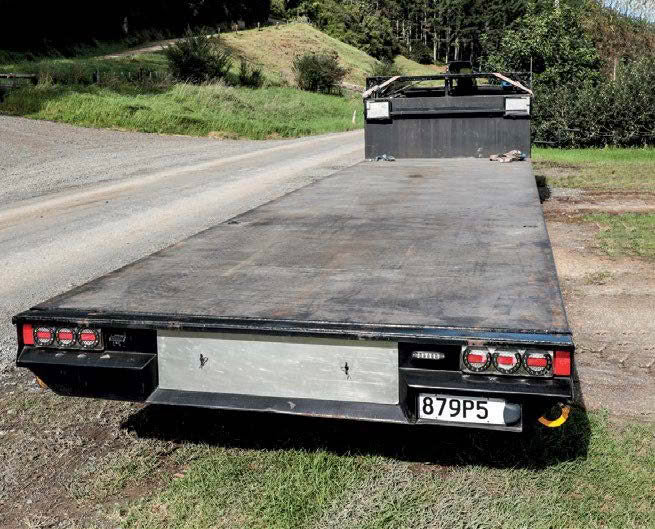
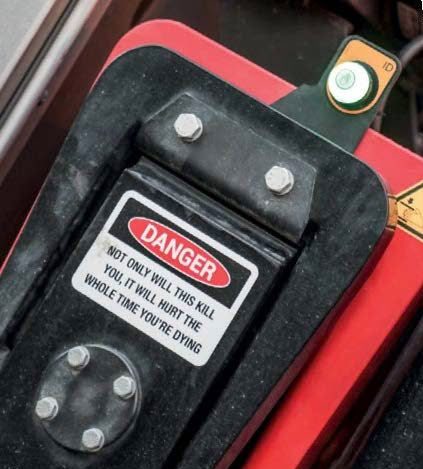
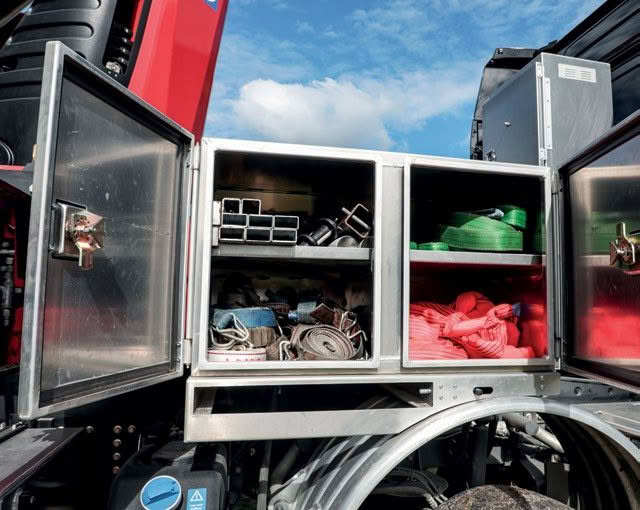
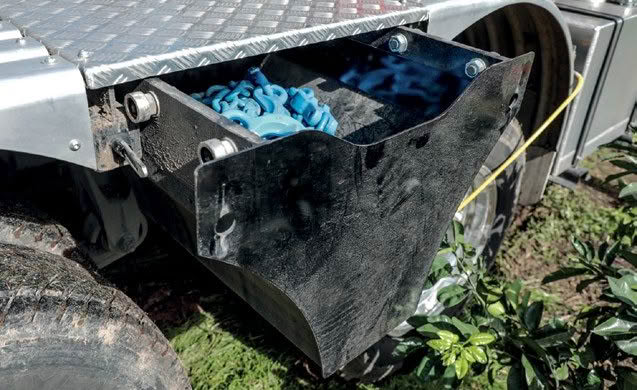
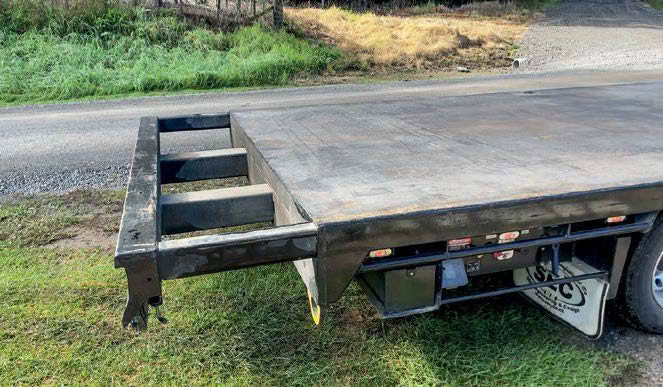
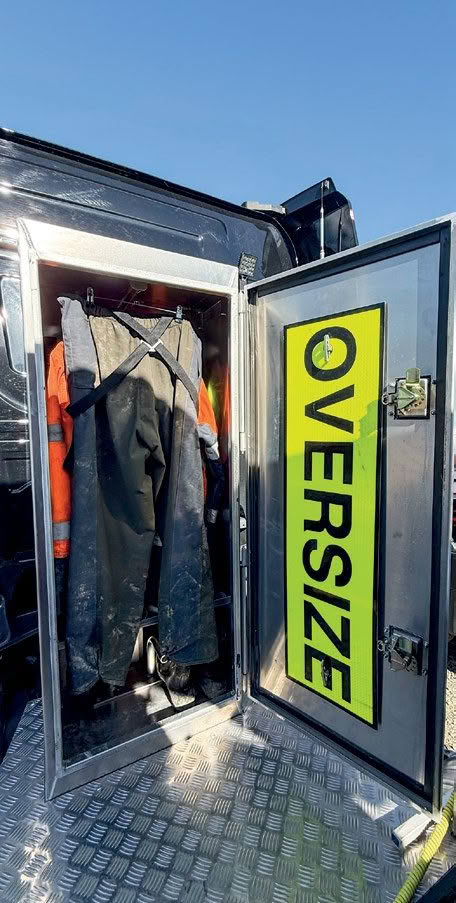
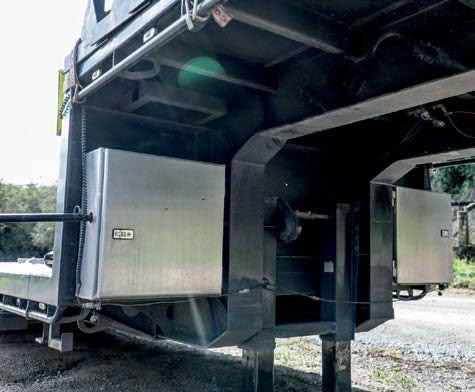
Photos: The SEC two-axle trombone semi-trailer is the latest in an evolving design made for Tiny Towing’s needs, including lockers placed under the step deck and a 500mm rear extension. Green buttons on each side need to be activated before legs can be operated … Warning label is the loudest and clearest health and safety warning we’ve seen yet. Locker positions were critical to getting the weight balance right but positioned for easy access. There’s no shortage of space, including handy rollout chain drawers and an upright raincoat locker.
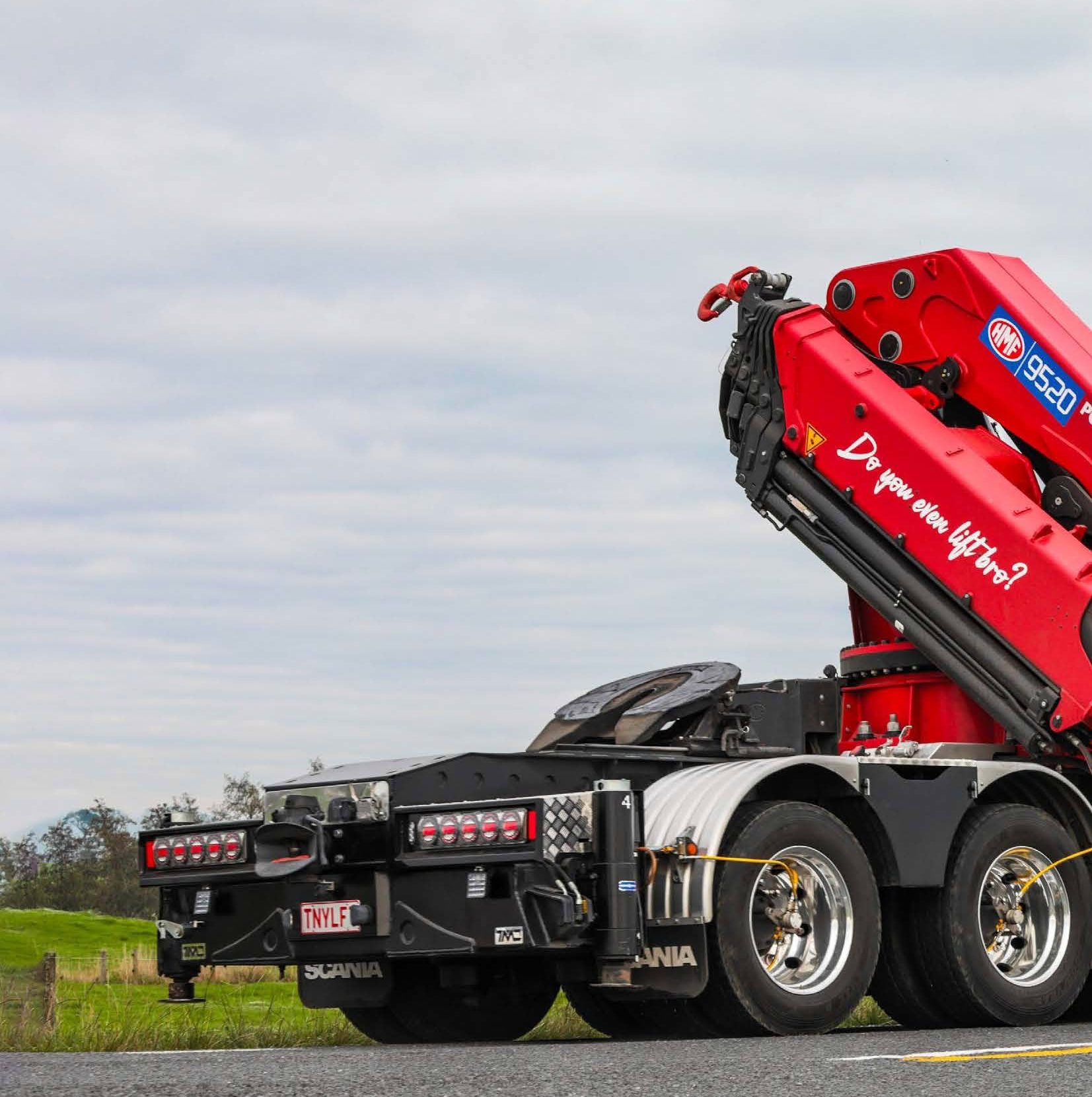
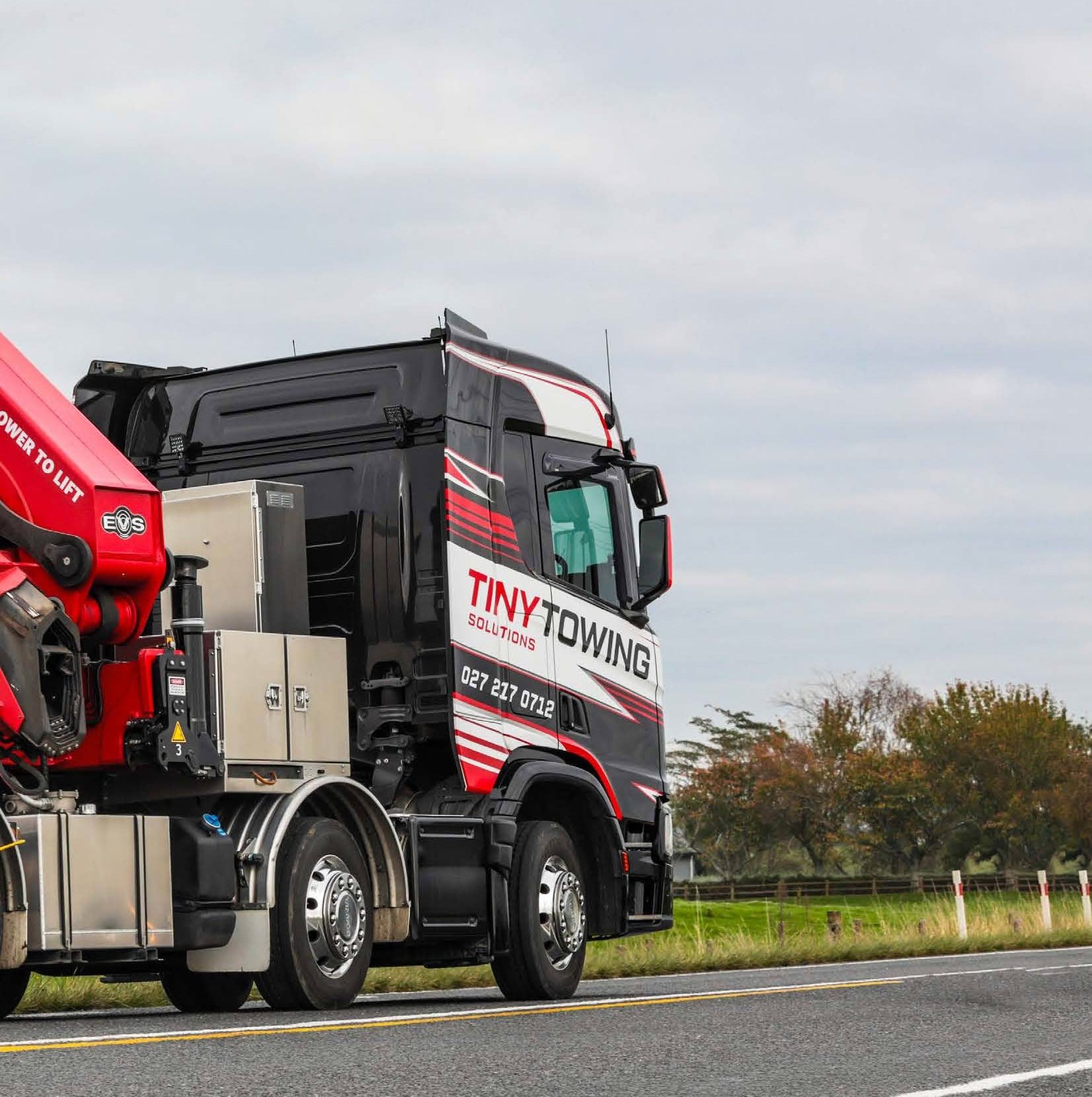
“We designed a complete 3D truck, crane and subframe model down to every little detail. From this, we were able to do all the calculations to make the build work with the right material to withstand the stress. Placing the crane and everything around it in the right place was critical to ensuring this build would work before we started.”
That’s the truck, but what about the trailer? Angus has had a strong relationship with Grant Colbran at SEC Group Invercargill since his early days in business, SEC having built Angus’ first trailer for the Ford F350 he operated (see sidebar Seizing opportunity). All subsequent custom builds have essentially been an evolution of it.
“That first trailer was mint and did everything we needed it to. Then, as we began moving longer buildings, we started looking at trombone trailers and built our first two-axle non-steerer (both sold). I’d also bought a triple-axle ‘grunt trailer’, an ex-container skele, which I got SEC to chop and modify to suit our long-distance work. It can cart a bit of weight so we can back-load some over-dimensional stuff with that if needed,” Angus explains.
“By then, I’d done a lot of research and followed the shed trailers they build in America; there’s some cool stuff over there. So the latest semi has a 9m deck and 800mm deck height. It trombones out to 12.5m, and we added a half-metre hydraulic extension, the electronic steering, Hyway Manufacturing ramps, flashing lights, pull out hazard panels and oversize signs on the back …” says Angus.
“Grant’s really good. Whatever I ask, he says, ‘Yup, I’ll find a way.’ You get great feedback from him – Invercargill is a long way away, but I’ve got no reason to change from SEC. Every trailer they do is better and better.”
The semi runs a 15-tonne axle set rating and is permitted to go to 18-tonne if needed. The combination runs at 41 tonne GCW but is again permitted to 44.8 tonne with the two-axle trailer. For those counting, the third trailer in the fleet is an old, refurbished, narrow-deck MTE house trailer.
And, apparently, Angus isn’t done yet … There’s a hybrid pull-type/mini house trailer currently in build for the big Scania, as there’s an upper limit to the weight that can be put on the fifth wheel when it comes to the biggest tiny homes. By the sounds of things, it’ll be a real nifty piece of kit: a pull trailer with a single-axle dolly, it will trombone and feature the rear extension and steering rear-axle set like the semis, all riding on airbag suspension.
The interesting part is the separate subframe on hydraulic rams that’ll lift the whole job half a metre to clear fence posts and the like. Oh, and by the time you read this, the Scania will have had its spreader-bar bracket fitted so it can operate as a tractor-only crane.
“I didn’t intend for it to do more than bounce around between our jobs, but now it’s on the road, people are ringing up for us to come in and help them with lifting. For that sort of thing, it makes sense for it to run truck only. That wasn’t a market we were chasing, but it helps pay the bills.”
Talk about a tool for every job!
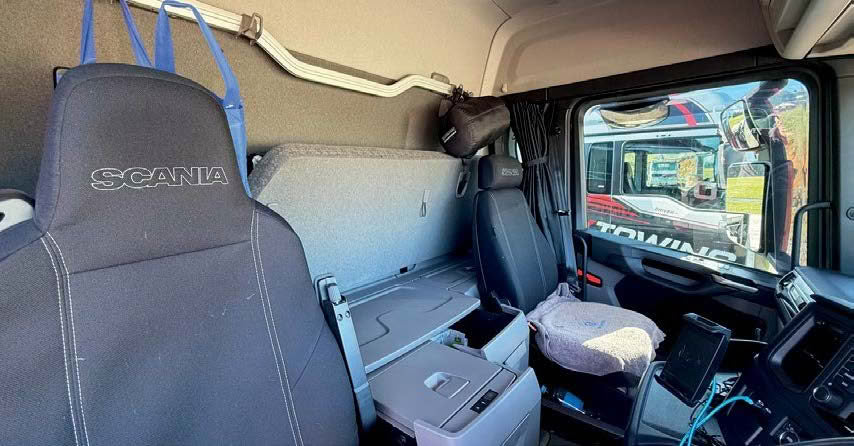
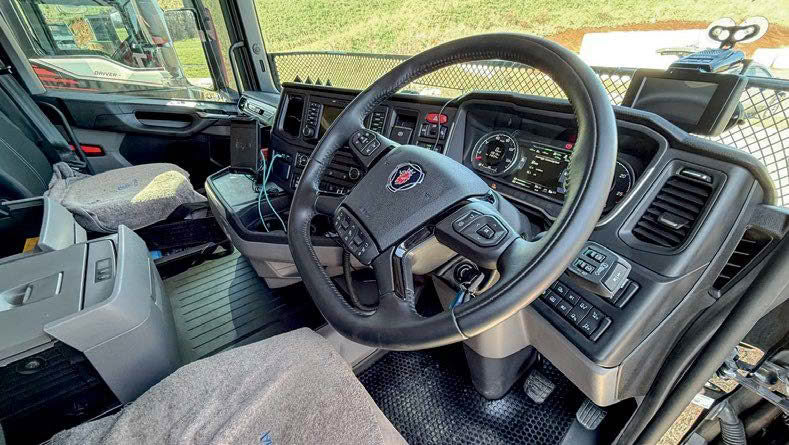
R-series cab almost feels compact after the many S cabs we encounter. Still perfectly workable, though.
Waitākere Weightlifting
So, then, back to the jobs at hand—the first of which was collecting a double-storey tiny house, 12.8m long, 3.3m wide, 4.1m high, and weighing about nine tonnes—from a section in the Waitākere Ranges west of Auckland, destined for repairs at Katikati-based tiny home builder Cocoon. The fully off-grid home had been emptied and secured, disconnected from its services, and released from its ground screws the day before.
“We can’t wrap it to repair it onsite due to space constraints; it’s way easier to take it back to the factory in Katikati, which is purpose-built for work on tiny homes,” commented Cocoon owner Tom Farr, who was on-site to aid Rob and 29-year-old pilot Nick Smilde and 26-year-old offsider Charlotte Maree.
With the house ready to lift, Rob assesses the conditions. There had been some significant rainfall in the preceding days, and while it was holding off, the ground was still very soft. The decision was made to park the trailer on the far side of the section and disconnect it from the Scania, which would be positioned between it and the house.
Slightly easier said than done—Rob would have to deploy everything at his disposal to get the Scania on site and manoeuvred on the very soft, wet ground. With a fairly narrow street and gate to the section, Rob engages the load transfer to more easily make the tight turn. Manoeuvring on-site, he locks the diffs and puts the TRT TractionAir CTI down to 30psi to maximise traction.
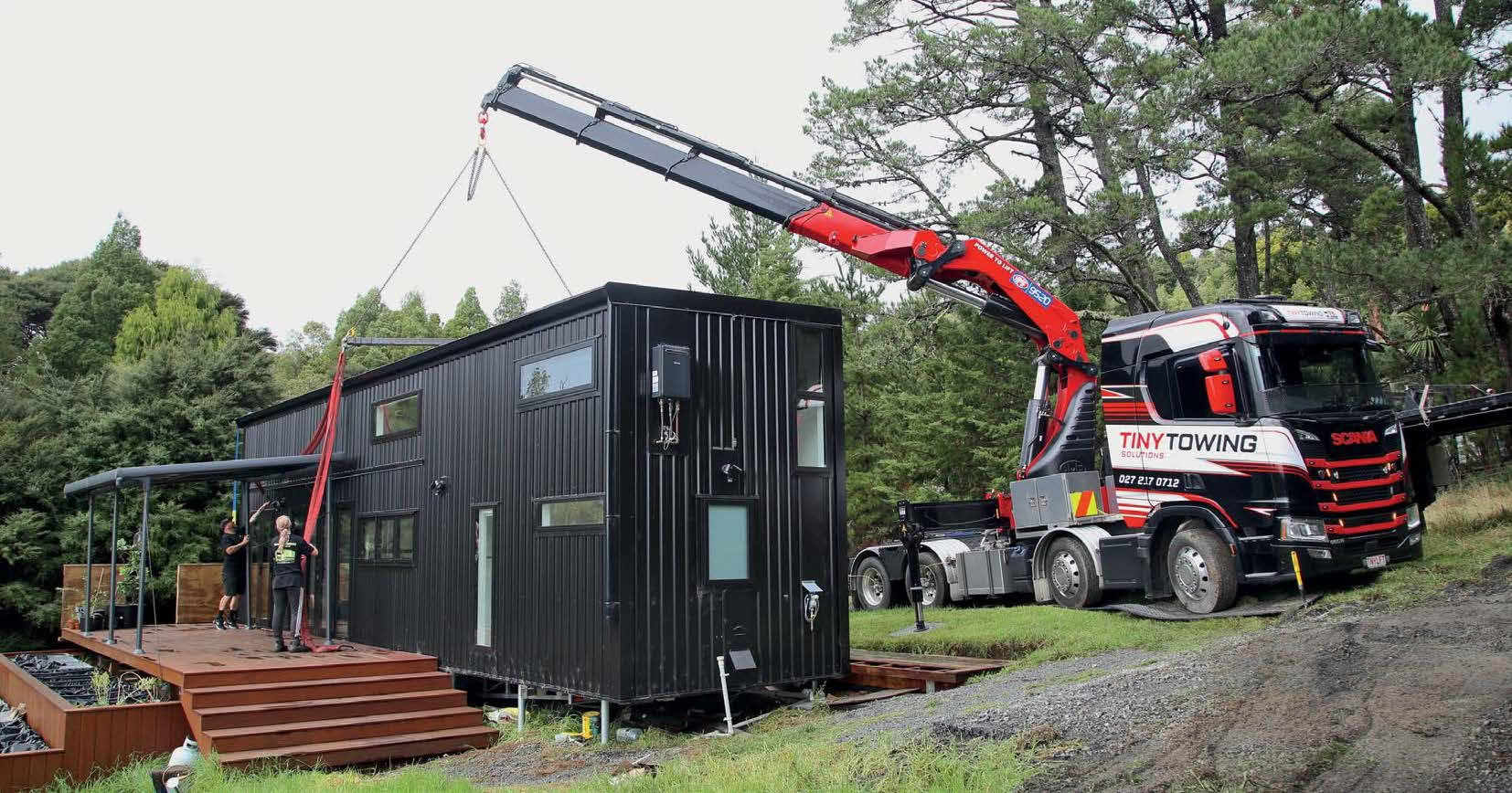
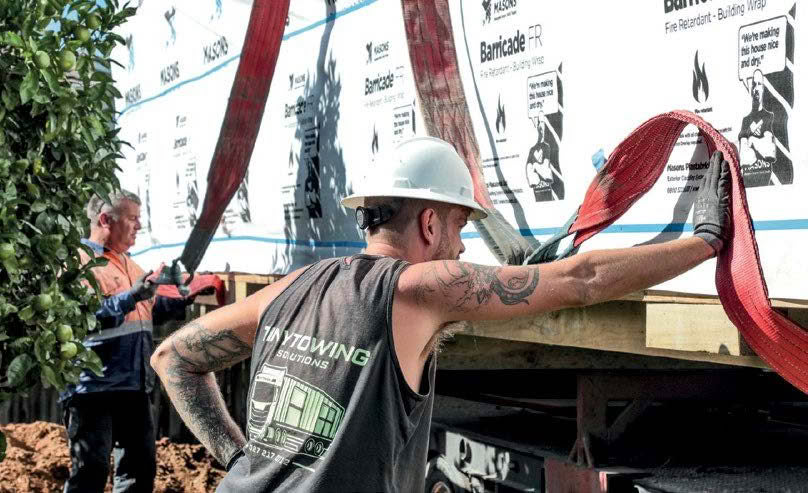
Even with the airbags raised right up, the ground is still soft enough to catch the Scania’s front bumper. With the deployment of a set of traction mats and some serious manoeuvring, he’s in place. The team works to position the lifting straps while Rob extends the stabilising legs, fires up the HMF and connects the spreader bar.
Before long, Rob has the crane overhead and straps connected, and then very gently begins to take the weight of the building. With it a few feet up and stable, Rob and the team lift and guide it around the back of the Scania and over to the trailer. Easy does it, and in all, it takes about 30 minutes to lift, load and secure the home for transit.
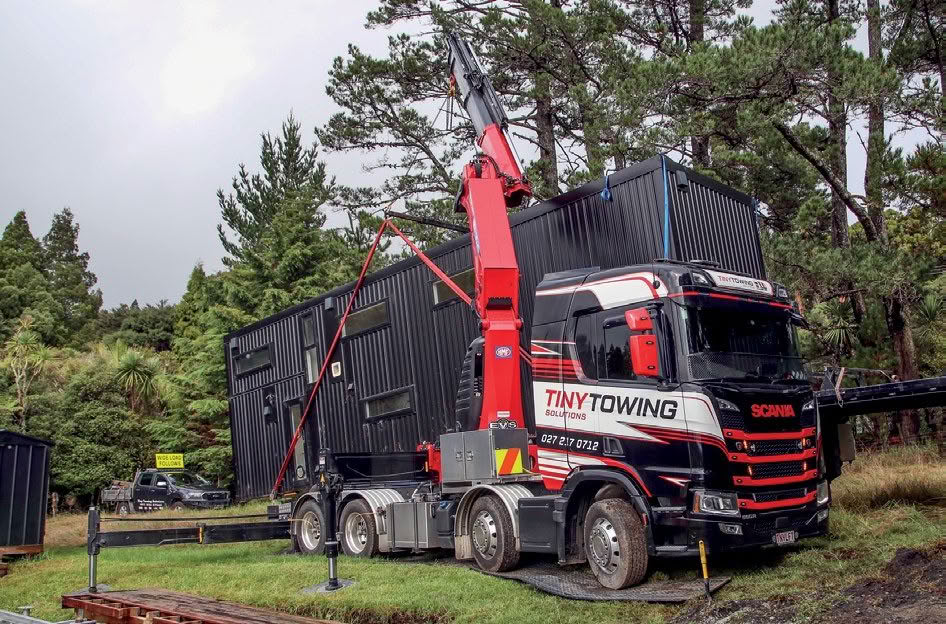
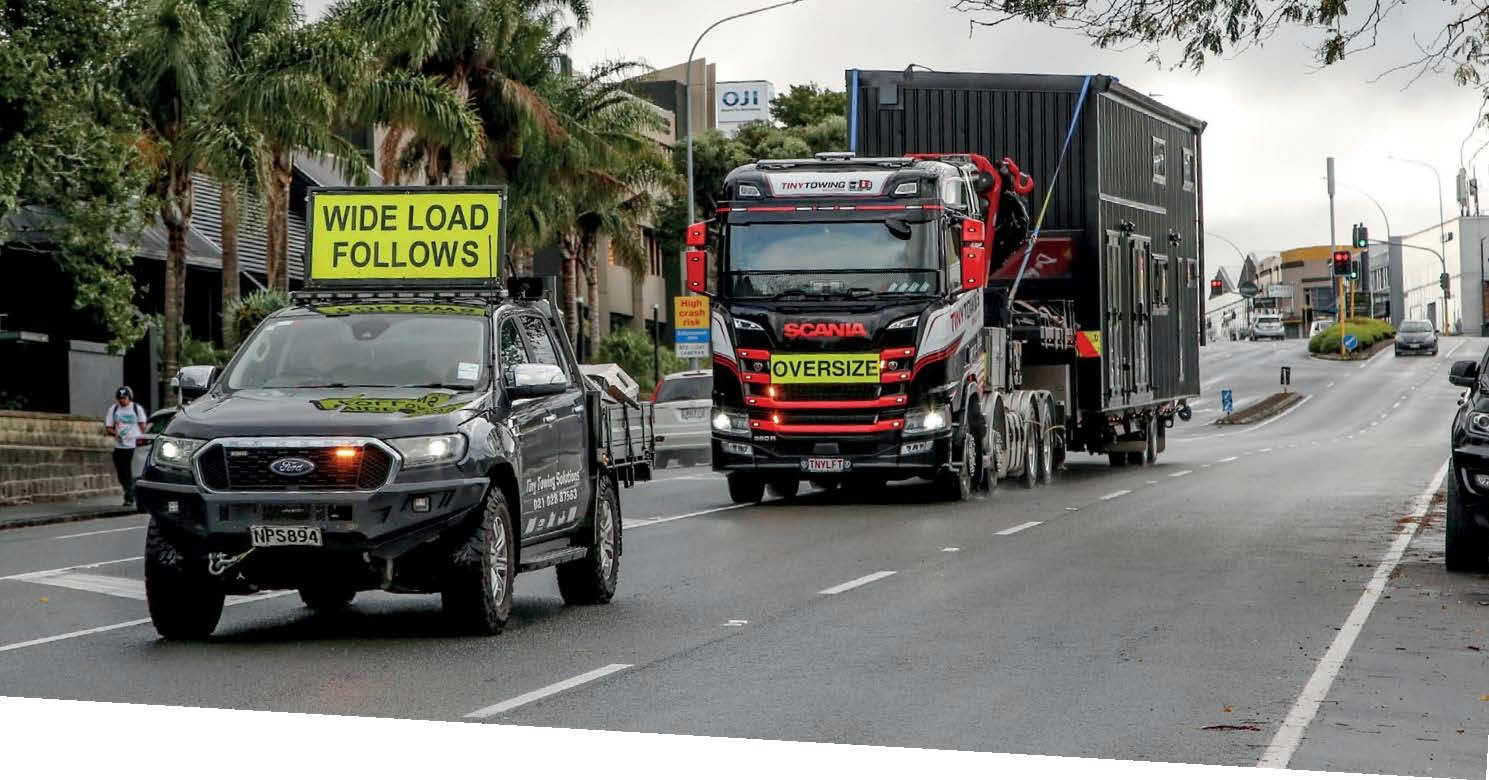
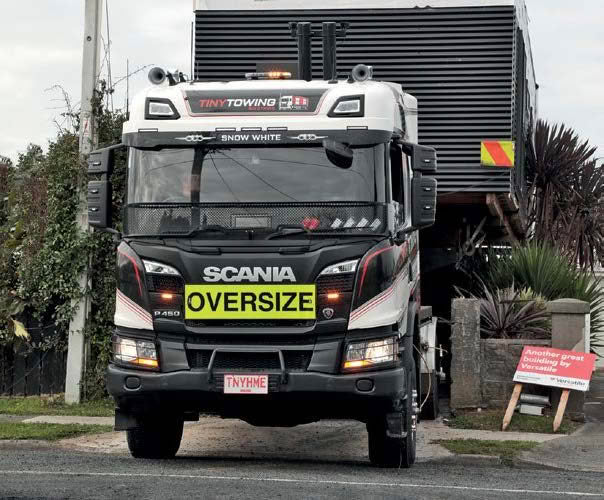
Getting out of site is the next challenge, made more difficult by the extra length of the trombone trailer. At least it offers roughly 150mm lift on its airbags, aiding ground clearance. Rob’s only option is to back out of the drive and into the street.
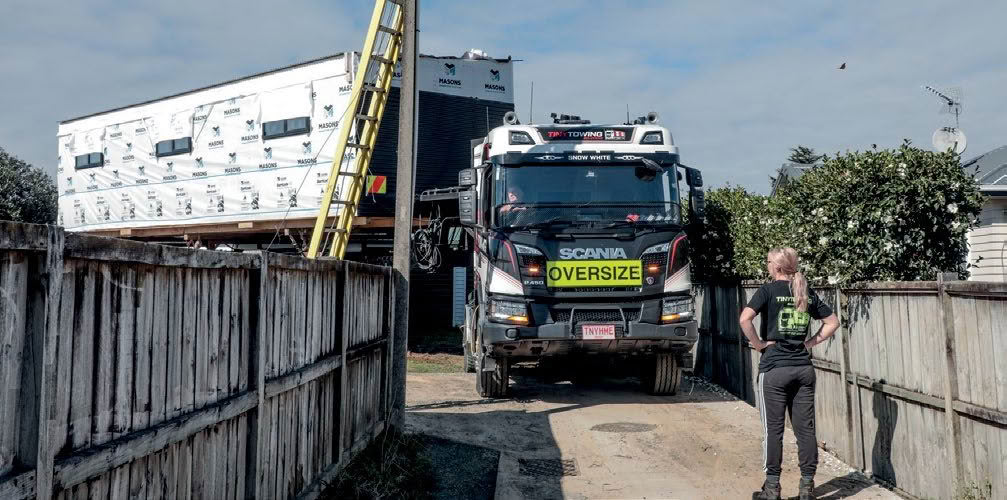
He reconnects to the trailer and slowly pulls forward into the drive. There’s much back and forth as Nick helps with steering the trailer. But there’s another problem: the mānuka trees alongside catch on the top of the house and the cab of the truck as Rob begins to back up, so Nick gets to work pruning a few branches with the handy Makita 18V pole saw.
With Charlotte and Tom holding traffic, Rob backs out with Nick helping to steer the trailer, being mindful of the deep culvert that could so easily catch a trailer axle. Bit by bit, they work the combination out into the road, with the advantage of the trailer steering immediately apparent. “It’s a game-changer,” Rob reckons.
The Scania clearly had a bit of a workout while backing and Rob reckons it would be good to have a clutch pedal for some added control. “The automatic clutch takes some punishment on this job. We have to do a lot of hill starting and pushing up hill, only moving three or four feet at a time. Even though it was in low range, it’s still not easy on it.”
A Super engine … and gearbox
In just under three hours on site, the team is ready to tackle the Auckland over-dimensional route and make for Katikati. Moving through Auckland is another challenge in itself, and the team is aiming to ‘get outta dodge’ before the 4pm curfew on over-dimension loads, meaning they’d have to park up until 6pm.
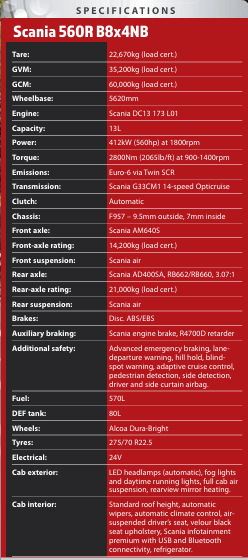
Spoiler alert … three hours after setting off, we have to pull over in Manukau, which means the team will only make Katikati well after dark. Nonetheless, the drive through Auckland gives us plenty of time to chat with Rob about the 560R, fitted with the new 13L Super engine and G33 Opticruise overdrive transmission.
The 560 is top of the 13L Super range – at 412kW (560hp) at 1800rpm and 2800Nm at 900–1400rpm, it offers an incredibly accessible power band – more so, considering the power begins to peak at 1400rpm. Those figures are also stepping into Scania’s 16L V8 territory, with a 395kW (530hp)/2800Nm unit at its lower limit, while bettering the standard 13L’s range-topping 402kW (540hp)/2700Nm outputs.
The Super also scores top trumps over its siblings, offering an engine-driven PTO of up to 1000Nm, and claimed fuel savings of up to 8%. Scania says this is achieved by an industry-leading brake thermal-efficiency level of 50% (seriously impressive for an internal combustion engine) and an integrated powertrain management system, while Twin SCR (dual AdBlue injection) “ensures a continuously higher reduction of exhaust emissions across a wide range of operations”.
The 13L Super also boasts a 350kW engine-integrated compression release brake (CRB), and Rob has at his disposal the trusty R4700D retarder for 4700Nm of ultimate hold-back. The G33 Opticruise is the second half of the Super equation.
Rated to 3300Nm, Scania says it’s 60kg lighter than its predecessor and offers numerous benefits such as 10% reduced internal losses due to improved oil-flow distribution, super crawler and overdrive gears, and four automated-shift reverse gears, with the option of eight reverse gears in total.
What all this means is that while the Scania is virtually fresh out of the box, it’s returning a 2.4km/L fuel consumption – incidentally identical to the P450 XT with 50,000km on its clock and a much smaller engine. And, while we didn’t get to experience the 560R under load on the open road, Angus says there’s nothing between it and the ‘lightweight’ XT when climbing despite the vast differences in tare weight.
“I love the 560; nothing wrong with it,” says Rob. “It offers ample horsepower for what we cart, which is never heavier than 12 tonne at the best of times. I’m more than happy with the truck. And it’s incredibly economical especially once you’re out on the open road.”
As we make our way through Auckland traffic, the Super pulls with a throatiness that would make its larger V8 siblings proud, and the G33 offers up some of the quickest, smoothest shifts we’ve experienced. Behind us, the SEC trailer tracks along well despite not being a self steerer.
“It does a good job manoeuvring through Auckland … but I do have to go wide when tromboned out because the wheels are far back on the trailer,” says Rob. “That’s fine, though. It’s a magic unit being able to angle the axles on-site and not rip up the ground when you’re confined with space.”
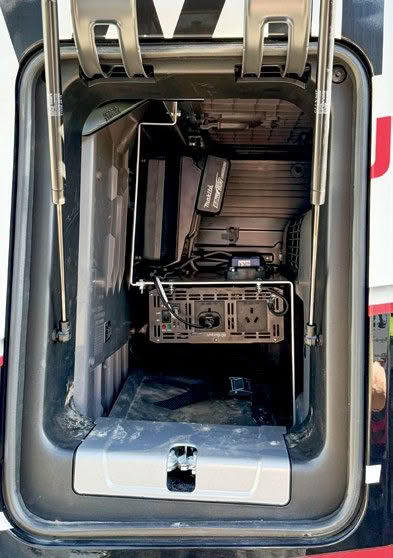
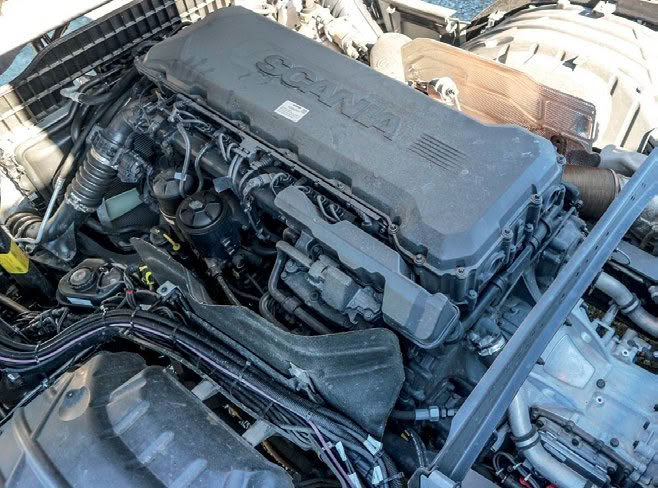
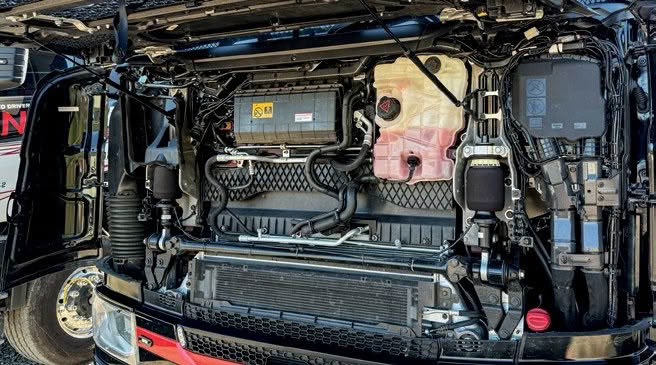
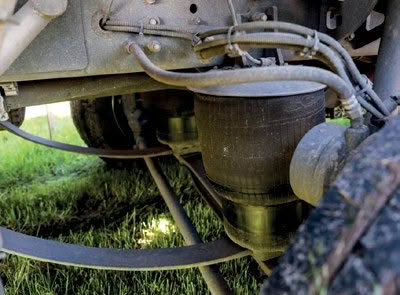
Full cab air suspension makes for a cushioned ride, while air suspension on all axles gives 150mm extra ground clearance.
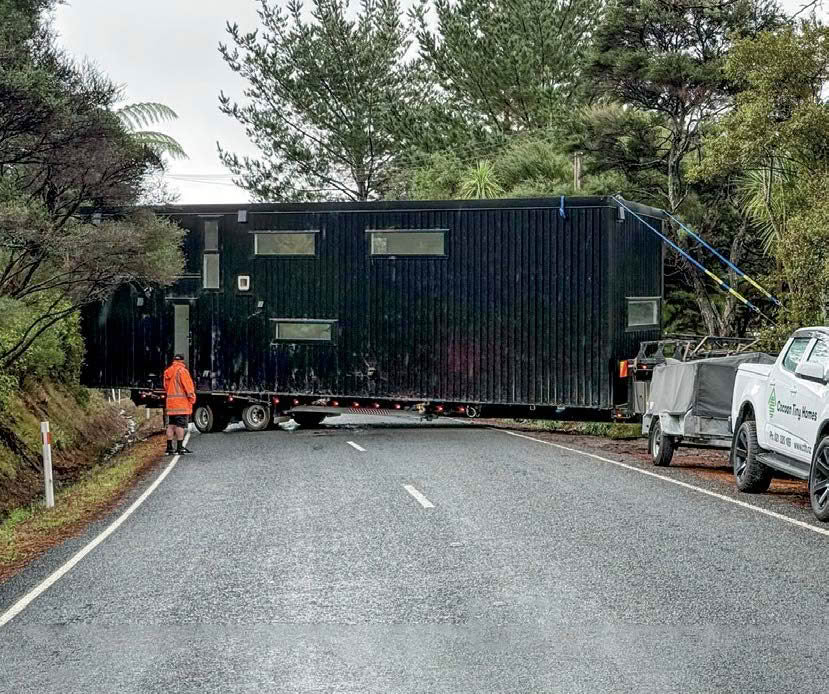
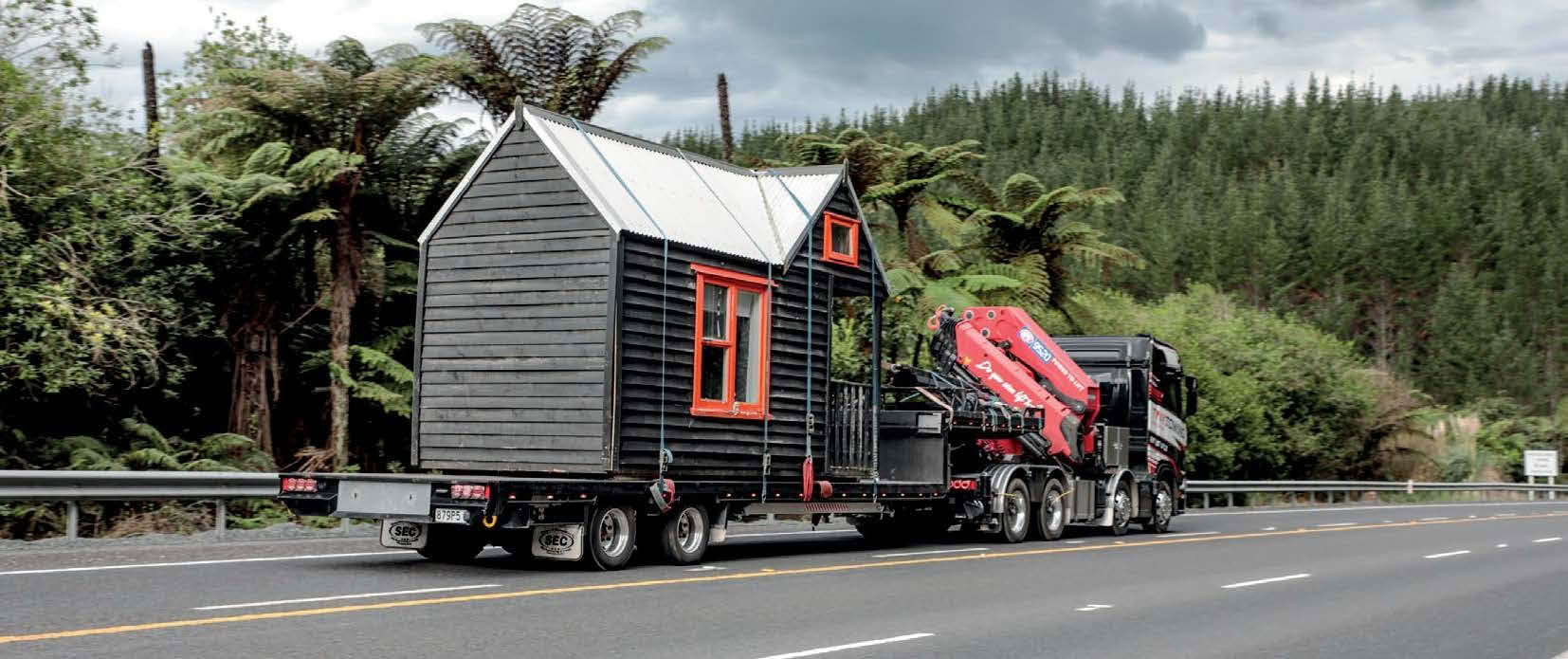
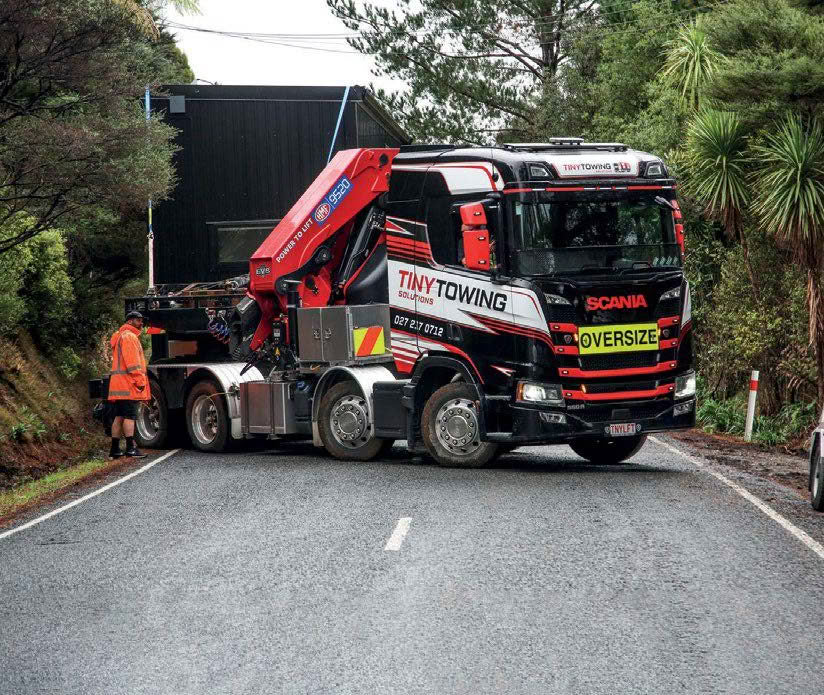
Rob backs out slowly but surely. Tailer steering comes into its own, aiding manoeuvrability.
Pukehina Push-ups
It’s true each site throws up its own challenges. Our second job is to move a small cabin from Pukehina in the Bay of Plenty to Putāruru – but while the load may be small at 5.6m long x 2.4m wide and roughly two tonnes, collecting and delivering it poses its own set of challenges, requiring Rob to think on his feet. Sure, site inspections are done, but often, the reality can be very different once the truck is at the scene.
“There’s a lot of thinking outside the square in this job – a lot. I need to look at the situation and think, ‘I’d do this, this, this, and this’, and then go and do it. I’m here to be a professional at my job and get it done to the best of my ability,” he says.
Today, Rob’s got the triple challenge of overhead power lines, soft ground and an even narrower gateway off a single-lane dirt road. He attempts backing the trailer in, but neither the gate nor the road offer enough space to turn the Scania and straighten out the trailer, even with its steering ability, while the soft, uneven ground is also causing traction issues. The decision is made to decouple the trailer, drive the tractor unit in, and use the crane to move the cabin to the gate and then nudge it out under the powerlines on some roundwood poles that are handily on site.
“Can you imagine us trying to get in here with a 10-wheeler?” Rob quips as he begins setting up the crane.
He has the truck’s air suspension set to raise when he engages the PTO. He then extends the legs and dumps the air from the suspension, so the truck settles on the legs. “The airbags try to compensate for the weight on the crane, and because they’re trying to equalise, you can think the truck’s going to tip over. So, once I’ve dumped the air, it should not put anymore in even though the bags are expanding [when the legs raise and level out the truck]. That gives you the greatest stability,” he explains.
Rob reckons the HMF is one of the best cranes he’s used. “This is a step ahead,” he says. “We’ve got a clear boom on this crane, which is a great thing when you have to get it up against something,” he points out as he nudges the cabin along.
Another handy feature is the remote with 4.3in colour screen, which shows the current crane situation in real-time across six different displays. “It’s a bit different to the old days when you were stood beside your truck and worked by feel. With the remote, I can see what’s going on and can wander around, but you can’t feel if the truck is starting to lift,” says Rob.
It’s this sort of job where smarts and experience enable the operator to look at the situation and assess the best way of managing it.
“The main thing is to not panic if things start to go wrong – always know where your down button is. I haven’t had to run yet, and I don’t intend to be that guy … I’d rather not wing it and keep going until something happens that ends up in a costly mistake.”
Before long, the cabin is bound to the trailer and headed for its new home in Putāruru – a suburban backyard. Despite more of an audience, with camera phones poised and neighbours enjoying the show, moving it in is a much simpler operation.
Rob drives in straight to the end of the drive, cranes the cabin over the house onto the ground, decouples and repositions alongside the cabin’s site, and then lifts it into position – the limitations of the tractor-mounted crane necessitating two lifts in this instance, as craning forward of the unit could lift the rear of the truck.
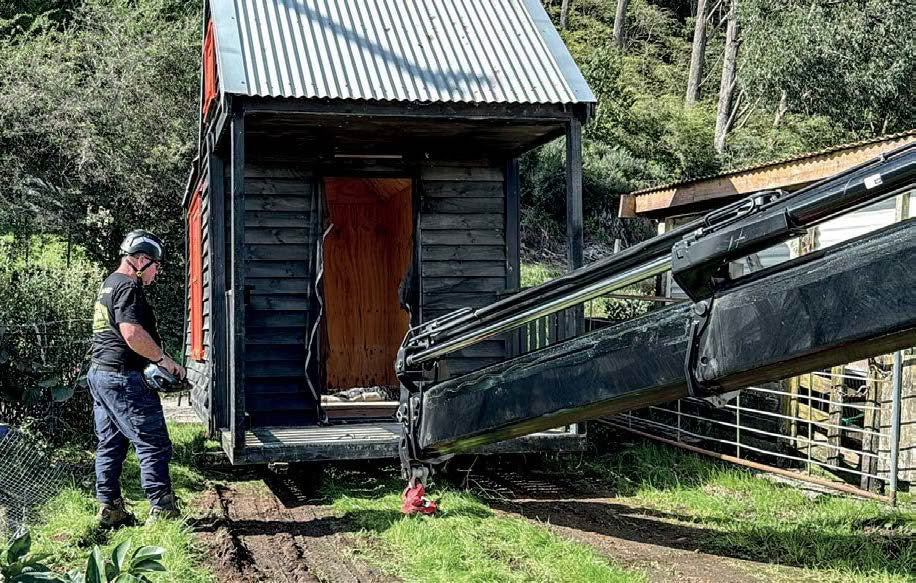
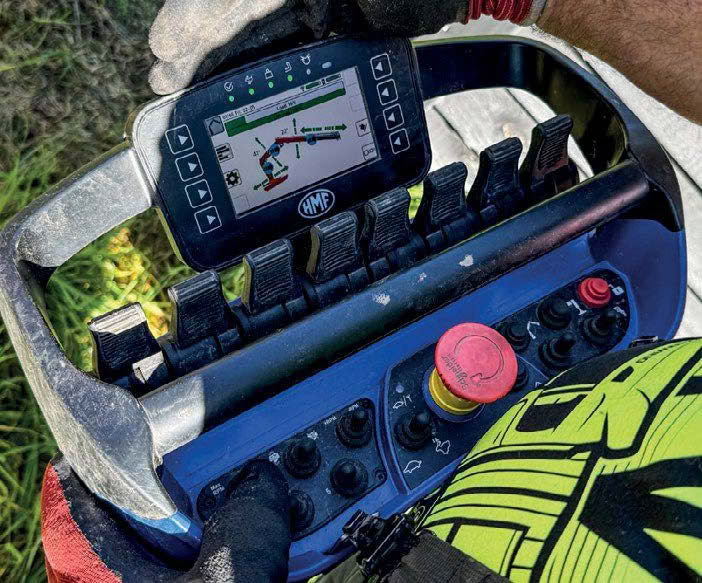
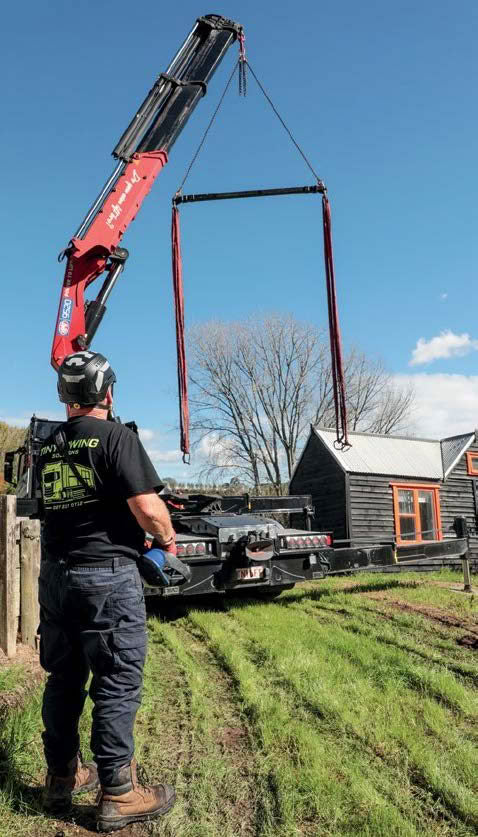
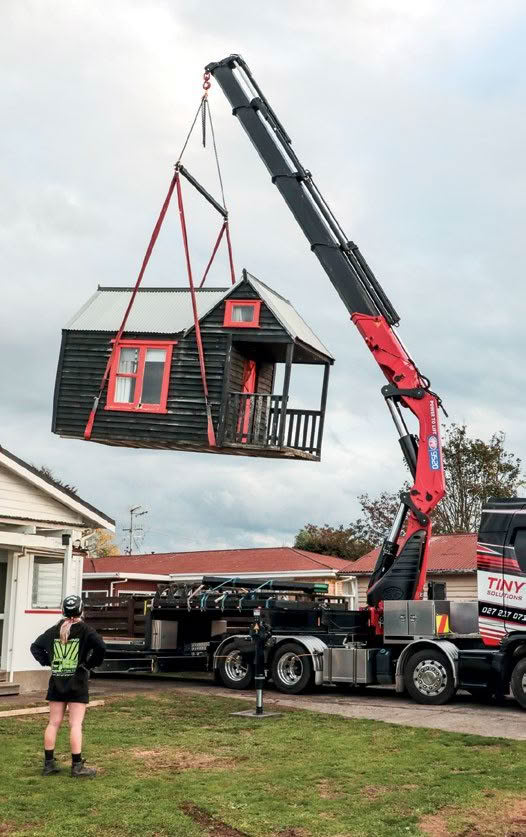
Top: Thinking on your feet to get the job done: Rob gently pushes the cabin through the gate under the powerlines. HMF remote controller gives the operator a large amount of live info. Bottom: Rob guides the crane out. Craning the cabin over the Putāruru house – almost home!
Morrinsville muscle
Some moves are a two-truck job, as with our final outing with the Tiny Towing team. A local move from rural Morrinsville just into town, Rob, Nick and Charlotte were joined by contract driver Grant Gibb in the P450 XT. This home is on the large end, needing to be split into two loads of 11.7m x 4m and 14m x 4m. The size, combined with a driveway at the delivery site that’s tight in every dimension from start to end and requires as much manoeuvrability as possible, means the XT and MTE house trailer are on the job with Rob purely on hand to do the lifting.
Rob has the spreader bar extended to 4.5m. Another tool made for the job, the spreader bar is built from a 100mm box section, extends from 3.1m to 5.5m and is 10-tonne rated. There’s also an additional 2m extension for additional versatility. “That’s also based on learnings from watching everyone else,” Angus explains. “Most spreader bars go to 4.1m, but some of the houses we carry are 4.5m wide. I wanted one that could do everything.”
The lift is a simple affair – just a couple of metres off the ground for Grant to back the trailer in underneath without the need for jacks. The delivery is another story, though. Backing up the drive is the main challenge; an overgrown hedge on one side, branches of the neighbour’s prized yucca trees and garage roof sticking out on the other, and a utilities pole at the top of the drive must all be navigated.
With about 2.1m of lift, the MTE offers the lifting flexibility and steering capability needed for awkward or larger shifts. While it’s an old girl, it’s been given a birthday to ensure it fits the company image and operates on the button.
“You hardly see these old narrow deck house trailers anymore, and those who have them never sell them,” comments Grant as Nick raises the deck.
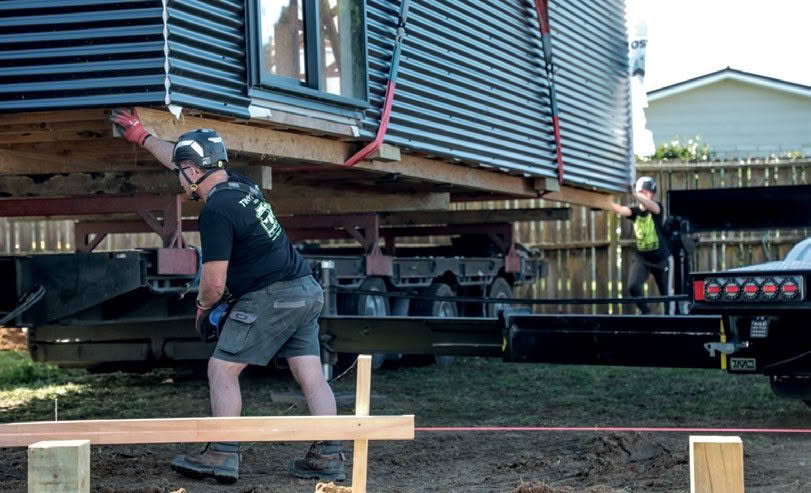
Though the house is sat on deck stands to raise it a further 450mm, the space is still too narrow, so out come the chainsaws to lop off some yucca branches and give the hedge a haircut. With Nick managing proceedings at the rear of the unit – raising, lowering, angling and steering the trailer as needed – and Charlotte acting as an extra pair of eyes up front, Grant manages to creep the house up the drive, around the utilities pole and up to Rob, who has the crane poised and ready.
It was a case of clear communication between the team and easy does-it every step of the way, with the XT’s short chassis and manoeuvrability clearly its trump card in this instance.
The team gets to work strapping the house for its lift and helps Rob guide it onto its piles, before packing up and heading back for part two of the move.
“The beauty of this job is we have these guys [Nick and Charlotte] along with us, and we can rely on them as part of the team – they’re not just contracted pilots. It makes the job quicker; they have the tools when we need them, they get hands-on to get the job done,” says Rob. “It’s a hard job, rough on your body, and the hours are harsh. You can’t rush these jobs, and there will often be delays or obstacles to work around. You can spend hours on-site. You’re buggered after a long, hot summer’s day. But we pitch in and give each other a hand to get the job done.”
Great strides
For a business started purely by chance, and relatively recently, too, Angus seems to be onto a winner with Tiny Towing Solutions. Rob probably sums it up best when he says:
“I have to give a lot of credit to Angus, as a young fella, to be able to pull off what he has. He’s taken a business opportunity and made it work. I have a lot for respect for him and what he’s done.”
Sure, the company’s arrival on the scene coincided with the tiny house boom, allowing it to take advantage of consistent work and quickly build up to some big numbers for a small operation – moving 90 tiny houses in its busiest month. There’s no doubt, though, that it’s been a steep learning curve.
“It was a hard industry to get into, especially the over dimensional side of it. It’s good having clean, decent, new gear and pro drivers on it. That’s gone a long way and allowed us to grow in the industry,” Angus says.
His approach of starting small and progressively building up with bigger and better equipment – and ensuring that equipment is the right stuff for the job as he’s learnt what works best over the years – has clearly paid off. And that goes for putting the 560R on the road, too – knowing what his operation needs and observing what does and doesn’t work for others.
Finding the right suppliers in Scania and Crane Sales NZ, the right equipment in the 560R and the HMF 9520, and the right engineer to build it in Truck Mounted, has resulted in a build that covers all bases to the finest detail. Combined with the neat job by SEC on the trailer, it’s an impressive combination built for the job at hand.
“Nothing’s impossible, it’s all doable,” Angus comments.
Tiny? Nah. After three days with this team, we think they’re big-as!
Special thanks
Our thanks to Angus Hamilton for telling us the story behind the Scania’s build and Tiny Towing’s journey. You’re onto a good thing; keep it up!
Thanks to Charlotte, Nick, Grant and especially Rob for accommodating us on three separate jobs and detailing everything along the way. You guys are great; loved the banter!
Thanks to Robbie Greenhalgh and the team at Scania New Zealand for their unfailing support of New Zealand Trucking magazine.