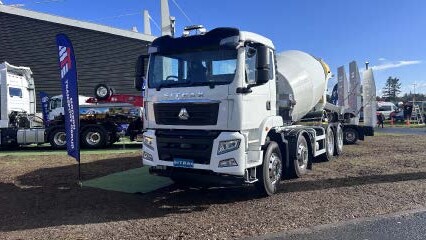
More than 1500 guests gathered at Mystery Creek for EROAD Fleet Day 2025, bringing together light- and heavy-fleet operators for a full day of industry presentations and networking.
Themes of the day’s event included road safety, team culture, and how to transition to new technologies. The event featured more than 20 speakers and 70 exhibitors, with keynote speeches from New Zealand rally great Hayden Paddon and former All Black captain Sam Cane.
Partnerships
EROAD chief product officer Mark Davidson unveiled a range of extended partnerships and outlined how new innovations will unlock safety, compliance and operational efficiency.
“We’re expanding our partner network to bring more solutions that help you stay compliant, safe and efficient.
“What also makes us unique is our global perspective. We have strong businesses in the US and Australia. We combine local, intimate knowledge with a global view – taking what works in the US and bringing it to New Zealand and often taking what works in New Zealand to other countries as well. That combination is really valuable and allows us to be an important partner for you.”
He confirms expanded collaboration between EROAD and digital mapping and location data firm HERE Technologies.
The partnership will power EROAD’s first vehicle-aware navigation application for Oceania. The solution will be available in Australia and New Zealand and is designed to enhance driver safety, fleet efficiency and regulatory compliance. It will be built on the HERE platform, leveraging advanced routing services and truck-specific data.
EROAD also announced an expansion of its partnership with telematics firm Geotab.
“By partnering with Geotab – combining what they’re good at with what we’re great at – we can bring solutions we didn’t have before, most notably a solution for light commercial vehicles. With Geotab, we can help with location, safety and robust data on fuel economy and energy consumption. We’re also launching a new solution with Geotab for the Australian heavy vehicle market to support heavy vehicle compliance. As we work with them and use that technology to bring heavy vehicle compliance out, it gives us the opportunity to sell the entire EROAD ecosystem.
“Third is a company called Whip Around, a New Zealand company focused on the service and maintenance space. We have a service and maintenance product suite we’re very proud of, and partnering with Whip Around allows us to expand into the entire service and maintenance process.
“Streamax – the world’s largest video telematics company – has been working in AI for 10 years. Our video-based safety products are based on our partnership with Streamax. A key deliverable from this partnership is moving from a single in-cab camera to multi-camera capability, improving safe manoeuvrability with side and rear cameras.
“What we want to do is continue to be your partner – whether it’s compliance, safety, or operational efficiency – not just for today, but for the future.”
Engaging your team in the fleet
The first panel session of the event looked at how operators can get good engagement from their teams about the fleet, and featured Sarah Warrender, light fleet coordinator at Fonterra; Blair Chalmers, transport operators officer for the New Zealand Defence Force; Bryan Sherritt, manager transport, policy and programmes at Waikato Regional Council, and Matt Gibson, fleet operations lead, KiwiRail.
Chalmers says one of the biggest barriers to changing your fleet is gaining trust from your staff. “They may not be overly confident about the initiative that you’re trying to put in place. Explaining it to them in detail and keeping them involved in the conversation is definitely how to get past that.”
Gibson, agrees, saying people’s perceptions are a key driver in any change. “There’s going to be a lot of negativity that you’ll hear, and you’ve got to turn that around and hope like hell that you can do it.”
Warrender says you have to make sure you can communicate what the goals are. “Also, talking with the people on the ground and just working through what those barriers or challenges are that they are seeing, or any sort of misconceptions that they have.”
Sherritt says when data says one thing, and your team says another, it is important to understand the context of the data and how it’s been collected.
“There are always limitations in data sets that you’ve got. But what is really important is listening to your people and understanding the context of the incident you might be looking at, because there’s always a story to be told, and understanding what that is is really important to build trust.” He says that’s where the engagement really starts. “That allows you to show your team how you’re capturing their data, how you’re using it, and how it can help them. What you really need to do is get them fully involved in the programme from the get-go.”
Gibson says it goes back to communicating the message correctly from the beginning, and change needs to start with fleet managers. “You want to engage with them first, explain everything so they understand it and can help you deliver it to the team, because if they’re not helping you, they’re going to hinder you.
“You don’t want people blocking your way because we do have to change, we do have to move with the times. It’s making sure that the fleet is fit for purpose going forward as well. All of that starts from leadership down.”
Sherritt says you can make a real difference in the middle part of your business. “Where top-down meets bottom-up is where the magic happens. You can get information from your drivers and to match that with the top’s expectation and outcomes that you need. That’s where I think you can make some big inroads.”
Chalmers agrees, saying middle management is key to whatever the initiative is to succeeding or failing. “If they don’t lead by example from the front, your other staff aren’t going to take it on. Getting them involved and making them passionate will help you drive that. They are key players in the whole process.”
Six pillars: New Zealand Police
Leighton Hamlin, acting national fleet manager for the NZ Police, says the police have a clear and future-focused strategy built on six key pillars. These include safety and reliability, operational efficiency, sustainability, cost-effectiveness, technology, and strong partnerships.
“The New Zealand Police fleet is incredibly diverse, operating over 4000 vehicles, including helicopters, maritime vessels, RIBs, motorbikes, and more. There was even talk of adding 150 drones at one stage,” he says.
“All of these assets support the operational needs of police across the country, requiring both scale and precision to deliver across land, sea and air.”
Hamlin says the New Zealand Police drives more than 78,000,000km a year, which is about 130 round trips to the moon. Officers attend 900,000 operational events annually. They own 95% of their fleet and lease the other 5%, and consume more than 8.5 million litres of fuel, excluding maritime and helicopter fuel, and complete 45,000 maintenance jobs annually. The average time off-road for a vehicle is 5.25%, which includes scheduled and unscheduled maintenance.
“The fleet team consists of eight people at a national level, including a fleet manager, an investment and delivery team, and a technical team. We work in conjunction with the 12 districts that cover all the regions in New Zealand.
“We work with various partners, including vehicle manufacturers, fitout specialists, comms specialists, and fleet management providers. We also work with other government agencies and have a partnership with the Australian Police Fleet Managers Association.”
New cost modelling tool
During the event, the National Road Carriers Association and EECA launched a new cost modelling tool in a bid to help freight operators navigate the shift to low and zero tailpipe emission heavy vehicles while remaining economically viable.
The collaboration addresses a glaring gap in national emissions planning.
Richard Briggs, group manager – delivery and partnerships at EECA, says the new total cost of ownership tool will enable fleet managers to compare options and better understand operational cost differences.
“Various elements such as fuel efficiency, route planning, driver training, and maintenance, combine to create opportunities for savings. Once you’ve got your fuel use in shape, and you do your homework around relative costs using different vehicles, the tool can help businesses measure, optimise and reduce their fuel and energy demand.
“And when you are ready to take that next step, EECA has the low-emission heavy vehicle fund, and that may help with a zero or low-emission vehicle, which provides up to 25% grant discount on the vehicle.”
James Smith, GM policy and advocacy at NRC, says the key to the new model is that it looks forward 12 months. “What we’ve found over the years and with our modelling is that if you’ve got a positive cash flow, net profit is normally reasonably straightforward. But without cash flow, you’re buggered,” he says.
The tool includes a calculation that will give users the carbon tons of any scenario that they are modelling. “It gives you a very good baseline of information that you can then use to move forward. We’ve got multiple energy types enabled, so you can run conventional diesel, hydrogen, electric, hybrids, bioethanol – and it’s very easy for us to add to if someone comes up with a new energy type.
“We’ve put a whole lot of additional cost inputs into it, so you can put in things like ferry crossings and things like that to give you a total run cost.
“But the most important thing is we’ve made it a lot easier for an operator to manage their own cost models. And the other significant addition is we’ve made it very easy to do comparative modelling, so you can see two options side by side.”
Hiringa: One year on
Hiringa Energy’s Andrew Clennett gave an update on the company’s hydrogen refuelling network.
He says hydrogen is a technology that is really suited to the “big end of town” – high utilisation logistics. “This is a really important message that we need to leverage: where in the logistics sector do you apply what technology?
“Hydrogen, just as a reminder, is something that refills quickly. It allows you to carry the payloads that you want, and it allows you to get the product where it needs to go. There’s minimal change from the existing diesel technology that we have,” he says.
Hiringa has to date built four refuelling stations that are all up and running. “Many of the stations are designed to fill trucks again and again. The idea is that we need hydrogen at scale to work. So we started with four stations, not one.
“The first stations are really to hit that golden triangle and the north–south route. It’s all based on heavy trucking transport routes, getting that coverage that we need.”
Clennett says Hiringa hopes to build 30 stations over the next 10 years and beyond. “What we’d really like to do is get, effectively, a full nationwide grid. We also need to make sure they’re in the right places.”
He says refuelling a truck with hydrogen is a very simple process. “There’s a lot of pipes, a lot of wires, a lot of smarts behind this, but at the end of the day, filling a hydrogen truck is really, really simple. Basically, you pull the nozzle out, you plug it into the truck. You have a fleet fuel card, you swipe that fuel card, and then you just press go.”
Clennett says the key to a successful hydrogen network is to lower the barriers to adoption. “We’ve had a lot of momentum. We are getting more and more trucks coming on the network.
“This is a commitment that New Zealand has made, that our partners have made, and that we have made. We need people to start to adopt this sort of technology – battery technology, hydrogen technology – into the truck fleets. It’s still early days, but there’s a lot to do.
“From our point of view, we are just getting going. But now’s the time to really get after it and start to build these fleets.
“The big thing we’re trying to do – as we build up, with the wind and the solar and the scale that we’re looking to build – is to start to drop the price of the hydrogen. And as more trucks get built, the truck costs will come down.
“We realise right now this technology isn’t in full parity with diesel, but I guess we probably also need to ask ourselves, what is parity with diesel? Diesel is a global-exposed commodity – we import it all. Is that really the answer?
“The actions that we do now, the way you present this sort of technology to yourself and your fleet and your customers, is going to really set up how successful and how quickly we can get our supply chains really humming.”
Is battery electric the answer?
Rebecca Wilson, head of business energy solutions at Z Energy, says there is a clear technology pathway to solving New Zealand’s transportation challenges – and that is battery electric.
“If you look at the amount of information coming out in the world at the moment around the energy transition, you would probably be right to think that it’s really highly disruptive. And let’s be honest, maybe a little bit chaotic.
“In the last couple of years with the improvements in technology and the advancements in infrastructure, there really is a clear technological pathway for solving our technology and transportation challenges.”
Wilson says that all the customers she has worked with who have been successful in their transitions – no matter what industry or size of fleet – tend to have the same five key elements: strategy and planning, people and change, safety and reliability, charging, and the vehicle.
“People are the most important component of your change to electric. I have seen organisations stop their energy transitions because their people refuse to get on board, and humans tend to be naturally resistant.
“The more that you can put change management around your energy transition, the more successful you’re going to be. What does that look like? Think education and training for your first drivers transitioning into electric vehicles. If you have a really resistant workforce, what incentives can you offer to help entice that first lot of drivers to then be change champions for you as you go through the rest of your transition of your fleet?
“What policies do you need to change or alter? Many of you will have fleet policies already tailored to specific vehicles. EVs bring a whole different policy change.”
As for safety and reliability, Wilson says people who work in transport and fuel live and breathe safety and compliance daily. “We deal with flammable liquids, refinery operations, etc. every day. However, electricity – and particularly as we move into heavy vehicles or complex use cases into electrification that are now charging with high voltage electricity – can be just as dangerous as those flammable liquids.”
Wilson says she hasn’t yet met a customer who only uses one form of charging. “Being able to charge across multiple use cases is usually essential. It also really helps with effective change management with your people. So, if you make it easy, people really don’t mind moving into something new.
“Think about how your drivers drive. If you have a heavy fleet, think about what constraints you may have on your site and is there an opportunity to share infrastructure via commercial hubs. As we move into heavy complex cases where there are grid constraints going on, we may have to see how we can band together and bring that demand together and aggregate so we can use the grid in effective ways.”
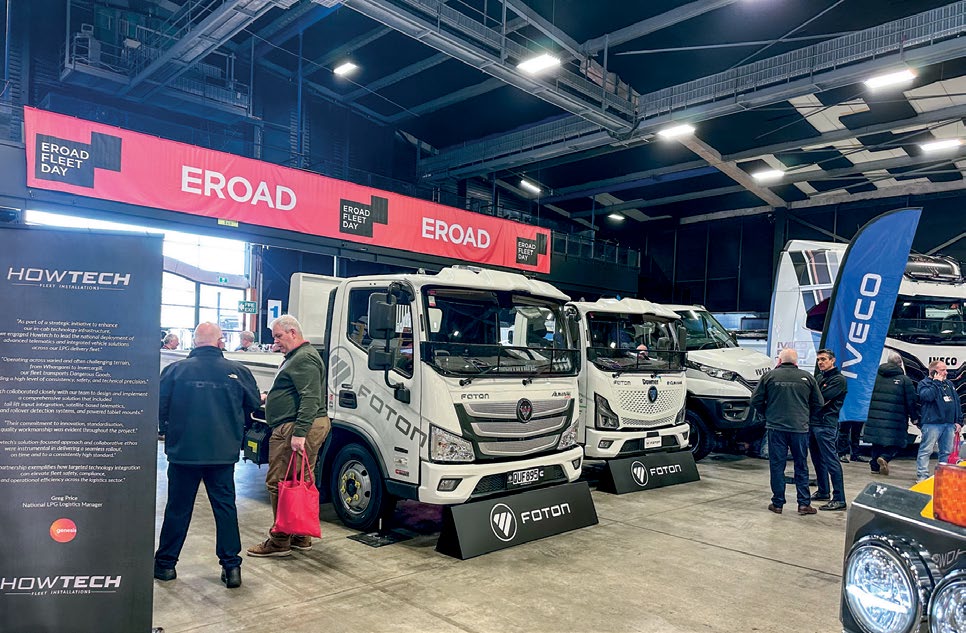
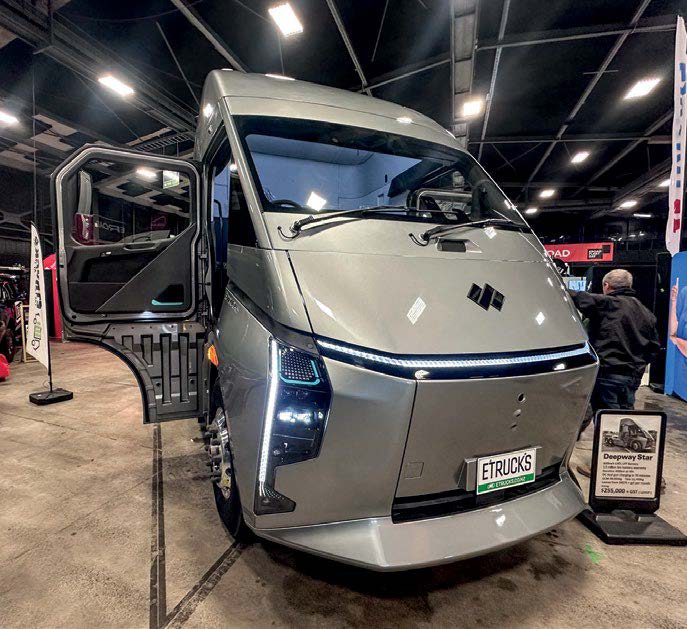
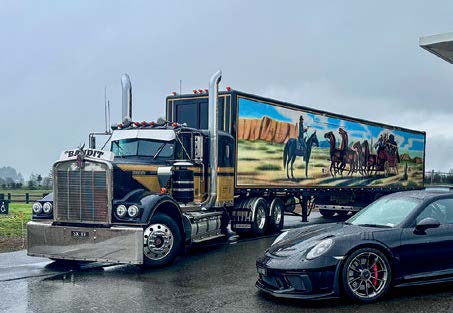
EROAD Fleet Day 2025 attracted many manufacturers from the industry. Etrucks debuted the new Deepway electric truck.